Monday, December 26, 2022

On Happiness


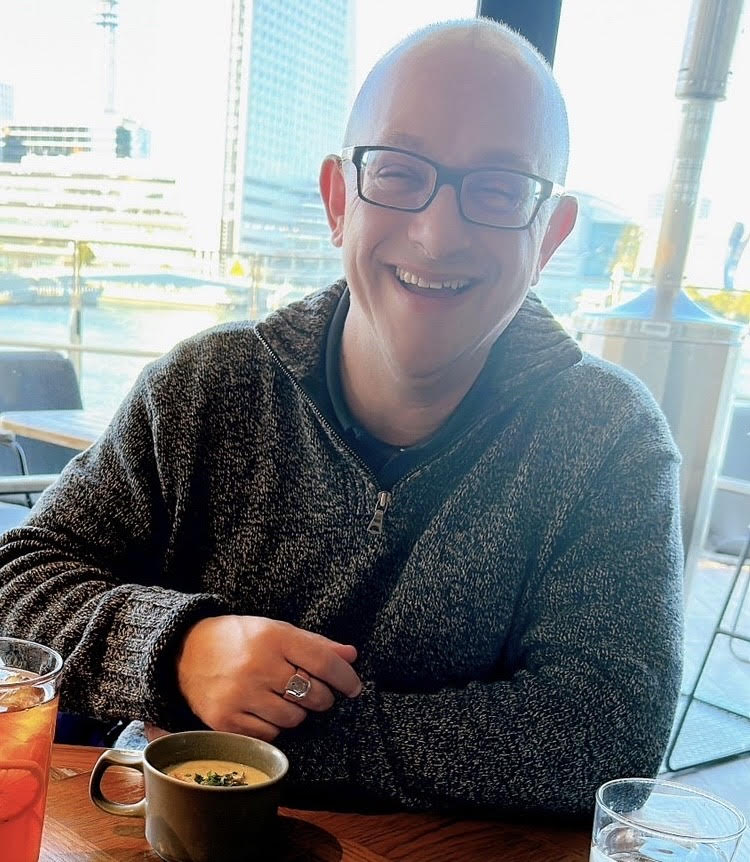
This is me. A photo taken in December 2022 at an outdoor cafe. Yes, I look happy. Because I am. Relaxed and in the company of friends, it was a very enjoyable lunch and conversation. It feels very different from where I was a year ago.

In Dec 2021 I was not happy. I was recovering from type 2 diabetes which was diagnosed in May 2021, and had been on months of medication, side effects of which were poor sleep and headaches. I had to endure those because I needed to continue to reduce my blood sugar. I was also under extreme stress at work. I was unable to help my stressed out team because I could not even help myself. Every day I felt like I was drowning, and there was no help to be found anywhere. The situation was relentless. I was working 70 - 80 hour weeks for months including nights and weekends and it still wasn't enough.  Every Sunday I would lie awake with anxiety at what new crises would happen the next day and I felt completely hopeless.

So, what happened?

By January of this year I became determined to change jobs. The internal transfer was not handled well, and that convinced me that I needed to change companies as well. I enjoyed my time in cloud technology but it turned out to be every bit as volatile as investment banking, and for many of the same reasons. I worried that at my age (55) despite my experience and skills I would struggle to find a good (enough) job, as I had in 2010 after I left JP Morgan. 

Fortunately, I was quickly able to find a great role in a buy-side asset management company's international sales department, leading a young and diverse team of developers, designers and UI specialists. My background in finance (albeit sell-side) and technology has been useful, as has my fluency in Japanese. I am doing good work and my work is being highly appreciated across the firm.

I learned a few very important lessons.

1) Sometimes what didn't really work out for you really worked out for you. Read that again.

Leaving the comfort and safety of Thomson Reuters (now part of LSEG) for "The Cloud" in 2016 was a very difficult choice to make. My current employer will make my 4th job in 6 years. Changing jobs is extremely painful and emotionally draining, and learning cloud solutions in my late 40s did not come easily. I had to invest a huge amount of time and energy on topics that others probably intuitively understood. However, if I had not gone through those tough times I might not have developed the important skills and understanding I need now to create the right solutions for my current employer. I met so many fantastic people and (hopefully) will keep and deepen my relationships in the future by being a good customer. If I had it to do over again, I would have had to choose the same course of events. As stressful as it was, it brought me to where I am now.

2) Prioritize Your Mental Health and Balance above all else

We often talk about the need for balance. This can be described as work/life balance but also as the "Holy Trinity" of mental/physical/emotional well-being that is the key to longevity. In my case, the high stress and anxiety led me to emotional and mental instability which ultimately contributed to my health issues. My poor health had knock-on negative effects on my mental and emotional health in a downward spiral that ended up out of control. In retrospect, I think emotional health was the most important factor to get right first. My happiness would have minimized my physical impact. Even working hard, if I had not been so stressed out/feeling hopeless constantly I think I would still have slept well, eaten better and found time to get more exercise. Many people can maintain a positive outlook even when they are not feeling 100%, but I think feeling despair will naturally disrupt mental and physical elements as well. No job, no career is worth jeopardizing any of the three factors and I am grateful I found another option before my conditions got worse. I felt that as a survivor of so many hardships, and a martial arts instructor as well, I would be largely immune from the effects of stress and anxiety on my mental/physical/emotional health. I was very painfully proven wrong.

3) There is ALWAYS something you can do - but you need courage (and to let go of your ego)

 As my situation deteriorated, I felt more and more helpless. I worked harder and harder, longer and longer, believing that I could work my way out of the negative spiral I was caught inside. I believed that if I got myself into a situation, any situation, I could get myself out. I told myself to "Man Up" and convinced myself I would do whatever I had to do to provide for my family, even die if necessary. I would have preferred to die than to fail, or so I thought. My family staged an intervention. It happened when my wife brought me dinner to my little room one night and told me that whenever she knocked on the door she worried that she would find me collapsed dead at my desk. She was very serious.

As a family, we spoke about it and they reassured me that this was not the way. I shouldn't risk my life for my job, any job, and that whatever changes I needed to make they would support me 100%. I made up my mind to get better. That would mean making changes. Major changes. It would also mean facing my fear of failure and letting go of my ego - stop trying to fight a battle I knew in my heart I could not win. I had to also stop worrying about what others would think of my many frequent changes - whether or not my bosses, my co-workers, my team or anyone else would judge me for throwing in the towel and quitting.

I had to believe that in the end, those who were meant to be my friends, those who really cared about me, would understand why I needed to do what I did. That is exactly what happened.

Far too many people fail to find alternatives to bad situations, or feel too trapped to make other, better choices. They worry too much about being judged or are too afraid of change. Far too many people fail to get the support they need or the mental health care they deserve. The truth is - it's never too late to make a positive change and a wait-and-see approach generally only makes matters worse.  

4) FUCK COVID

Yes, I said it. We've all been thinking it. This horrible disease has taken so much from so many, devastated families and workplaces, and even fundamentally changed the nature of work forever (hopefully for the better). I cannot and will not blame COVID for everything, but in my case it made a bad situation worse and added so much additional stress to an already challenging and difficult situation. During COVID, we were prevented from seeing each other, prevented from seeing customers or friends and this led to terrible feelings of workplace loneliness and isolation. Every day was a poor carbon copy of the day before - 10 or 12 hours of back-to-back Zoom calls and desperately trying to get a bathroom break in-between. No time for "actual" work and no way to build the all-important relationships that make work worthwhile at all. Everyone tried to make up for it with ergonomic chairs and virtual happy hours but they were all poor substitutes for actual face-to-face human interaction. I was miserable and COVID was a big part of that. No, the time of COVID is not quite over, but the world is finally moving on. One day all of this will be nothing more than a bad memory as we all mourn what we have lost and the high price that has been paid by everyone worldwide.

Closing

Happiness is not automatic or guaranteed. Part of knowing what it is comes from experiencing what it is not. 2022 has had its fair share of challenges, but I am very grateful to end the year in a far better place than where I started it.

I wish all of you a safe closing of the books on 2022 and all the very best in 2023.          

Sunday, December 18, 2022

Navigating Things


(thanks for the inspiration SC)

We are often conditioned to think of our lives as being on a kind of "auto pilot". We enter the details of our destination - education, hard work, dedication, perseverance, luck, money - and the Life Autopilot delivers us straight to --- SUCCESS. In many families, especially Asian families, the auto pilot includes enormous pressure to have perfect grades, play musical instruments and sports, excel at after school enrichment activities and if we do so, the autopilot will take us to success as a(nother) lawyer or doctor - ironically, even if this is not where we ourselves wanted to go.

We think we depend on a few critical "all-or-nothing" moments where our lives are defined. Those moments where we truly rise up and make the decisions and take the actions that will yield the fame and fortune we desire. Sadly, when we do not win those moments, we may feel that those doors to success are closed forever by our failure, and those potential futures lost to us. This way of thinking can cause us undue stress and anxiety and in some extreme cases may suggest to us that all is lost and we will never achieve our life goals - leading us to despair, depression and maybe even to self-harm.

In fact, Car Navigation systems may be a better metaphor than Autopilots.

Car Navigation systems are wonderful things. They allow us to input a destination and then provide directions to it, even allowing for various conditions to be set (don't use toll-roads, avoid traffic jams, etc.). These days, an intelligent AI voice tells us each turn to make and exactly how far to go.

Using this metaphor, like car navigation, sometimes despite the instructions we miss a turn off or overshoot an exit ramp or on ramp. Then what? A fiery ball of flame? No. The navigation system will calculate a new path to get us there. Even if you start going in the exact opposite direction of the system's instructions (like me when I use Google Maps), the system will patiently direct you back on course. Your journey is only truly over if you give up.

Life, it seems, is very much like this. Contrary to popular belief, we can even decide a direction without knowing the actual specific address. We can simply enter something close. We can change our minds en-route or make a detour or a stop off. We can make an unlimited number of mistakes. A new route will always display that tells us what to do from where we currently are. The Navi will always keep trying to show us the way. 

In the end, we will get where we are going as long as we don't give up.

When we are ready to accept our own freedom, we realize that there is no timeline or schedule for reaching our destination (success/happiness) except our own. The fact that others may have taken a faster route or arrived earlier or been more efficient is of no consequence. What matters is that in the end WE ARRIVE.

A Navigation system does not necessarily need every little detail to plot a course. Newest ones can use a partial address or even just a telephone number. They can navigate using a famous landmark or a place you have previously visited. Life, too, need not have every tiny detail in place to help guide you in the right direction. So get started. 

2023 is around the corner. Instead of just feeling lost, let the New Year bring you the chance to go on an adventure or two - secure in the knowledge that your trusty Navi will always get you there and back again.

Train hard.     

Sunday, November 20, 2022

Learning Kanji


Kanji (漢字) are the pictograms used in writing Chinese and Japanese. Originally Chinese, Kanji have been part of the Chinese diaspora and influenced not only Japanese but Korean as well. Many Koreans still have kanji associated with their names, and until recently there was still a kanji newspaper published in Korea.

I started studying kanji as part of my Japanese class in 1989 and have been studying them in one way or another ever since. Modern Japanese (newspapers) are based on a general usage set of 1,945 characters, but most adults know between 3,000 - 5,000 based on their education and interests. It is said that there are over 30,000 kanji in Chinese including very obscure ones and derivations.

I love the fact that kanji are pictograms rather than phonetic like western alphabets, since as they say, a picture is worth a thousand words. Kanji can be very efficient to transmit ideas to the viewer.

In the case of the above kanji, read "naka" or "chuu" in Japanese, it symbolizes the center or inside of something. This kanji was relevant in our class on Friday night.

In this cycle, we are working on hubud lubud (FMA sticky hands) applications including Hakka Kuntao, which is a southern Chinese martial art. I came up with the image of this kanji to reflect one of the central principles of Hakka Kuntao. In Hakka, our focus can be imagined as the four corners (both shoulders and the points of both hips) as well as the center line. Using the kanji, we imagine a square drawn connecting the four points with a line running down the center line (spine). Our objective then becomes penetrating the opponent's square to seek control of the center line, while simultaneously protecting our own square and denying the opponent access to our center line.

The shoulders and hips are predictive indicators of center line movement, so by using our peripheral vision we can anticipate the footwork (hips) or attacking line (shoulders) by watching the four corners of the box. Accessing the center line, usually via the head/neck/spine, allows us to easily compromise the opponent's balance and reduce or eliminate the ability to generate power through spinal rotation. Once this power train is disrupted it is very difficult for an opponent to deliver any meaningful strikes or recover their balance.

Hakka Kuntao is fast and powerful, concentrated on the box and center line, which makes it especially effective at very close ranges, despite the fact that many Wing Chun practitioners (Wing Chun is a representative Hakka martial art though not the only one) contend that it can be effective at medium and long ranges as well.

In Kali Majapahit, we use hubud lubud's framework to introduce several key bodies of knowledge including:

  • Gunting series
  • Hakka 5 Gates/Trapping
  • Application of aikido's te no tori drill
  • Knife and karambit flows
  • CQB stick trapping
  • Sarong and scarf applications

It is a cornerstone training tool and worthy of deep investigation and committed training.

More information here:

https://martialartsdigest.blogspot.com/2014/04/hubud.html
https://martialartsdigest.blogspot.com/2018/12/hubud-lubud-revisited.html     

Saturday, November 05, 2022

Reach Out


It seems like lately everyone is dying - more specifically, it seems like many people are committing suicide - either directly, or indirectly via alcohol or drug abuse.  Of course, notable celebrities attract attention regardless of whether they are rock stars, sports personalities or TV and movie stars.  This trend is discussed a bit in a paper here.

One of my country's greatest problems is one of multi-generational, hereditary poverty, a situation where Americans are born, live and die below the poverty line exactly as several generations before them did and just as they expect their children are likely to do.  This problem represents generations of families in the USA who believe, quite rightly, that they have been ignored by government - discarded in favor of a more influential middle class and wealthy elite who can donate and support them.  Exactly the constituents a candidate should advocate for, provided they actually cared about anything other than just remaining in office and milking it for every last drop of personal gain.  Sadly, these voices fail to have been heard for the better part of 80 years, leaving these groups of people in despair at being ignored and denied their basic human dignity and respect.

In the US we are taught to equate wealth with happiness, but the reality is not so clear.  According the to World Happiness Report, the largest study of its kind, the US ranks a sobering 18th, well behind many countries with lower GDP, notably including Costa Rica (13th). Money, it seems, is not everything.  However, we cannot ignore that those at or below the poverty line continue to suffer in misery with little hope for improvement under the current regime.

In many cases, these poor white people commit suicide.  In some tragic others, they act out on their feelings of resentment at their societal isolation and make a statement with their AR-15, shotgun or hi-capacity semiautomatic pistol.

The paper shows that despite these feelings of racist superiority, hereditary poverty affects whites just as badly as it does poor blacks and Hispanics, sandwiching them between lack of healthcare or quality education and perpetually low wages.  This leads to despair and desperation born of the hopelessness and fear of knowing that one's children will toil with no greater hope of success than any of the prior generations had.  So much for white superiority.

In another generation or two, the paper suggests, poor white mortality and imprisonment will equal or exceed that of black people, irrespective of police bias.  The race to the bottom continues unabated.

Sadly, this is an even greater argument for all of us to see beyond race, color or creed and to acknowledge that at the poverty line or below, all poor people have the same needs and must join forces to create social change.  For those of us above the poverty line, we are obliged in our compassionate society to give what we can to promote literacy, better education, healthcare and wage growth to help these people rise above.  We must influence action by our elected officials to allocate tax dollars to those who need them mist, rather than just enact tax breaks to further benefit the wealthy.  Overall, we must preserve the dignity of these people and remember that our country was founded on the principles of equal opportunity, acceptance and tolerance.

According to the very powerful book "Factfulness" by Hans Rosling, the world is far better than most of us think it is.  Dramatic increases in global wealth, education and health have been taking place and helping make a difference in the lives of many people, far fewer of which live in absolute poverty than ever before.  This is inspiring, and should remind us of our commitment to keep improving until not one single child is lost to preventable diseases, famine or war.

Meanwhile, at least according to our GOP, immigrants stream across the border to eagerly scoop up their entitled benefits of free education, low-cost healthcare and high(er) wages, thereby increasing the pressure on an already downtrodden demographic and adding exponentially to their feelings of despair.  Decades of systematically trying to skew the system against non-whites have failed, leaving "privileged" whites behind immigrants in both academics and opportunity.  In a desperate appeal to seize power not unlike 1930s Germany, our Republican Party appealed to the anger and hatred of this demographic and mobilized them to act out on their xenophobia.  America faces the darkest moments in recent history as we tear ourselves apart from within.  Our enemies in Russia, China and North Korea laugh as we push away our allies and descend into hopeless bickering among each other, all the while ignoring our fundamental moral compass as human beings.  This is the greatest tragedy of all.

The time for divisiveness is over.  The time for hatred and fear is ended.  Do not lose hope.
We must learn from our mistakes and put the past behind us so we can move forward AS ONE TRIBE.  The time for TOGETHERNESS is upon us.

Be Present
Send Peace
Donate
Hug
Love

BE THE LIGHT.


Friday, August 05, 2022

We're Here


"We're here to get through this thing together, whatever it is." - Kurt Vonnegut

The night air was cool and moist as we walked home. My teenage son was telling me about life at school. Instead of usual snarky comments and sound bites, he was opening up and telling me how he really felt. 

"The girls have two basic stereotypes", he said, "one group are really concerned about money, clothes and IG and showing off. The others sleep around, hang out in clubs and whatnot. Everyone is just trying to fit in." Surely they can't all be like that, I thought. It's hard being a teenager. Life is moving quickly and you're caught in the middle of definitely not being a child anymore but not quite having the wisdom or experience of an adult.

My own teenage years were... difficult. I was filled with anger at being a foster child and all it entailed. Sick of all of it, really. Bored and tired of social workers and therapists and of feeling lucky that things weren't worse than they were. I didn't feel like I fit in anywhere and I just wanted to get away from it all. It was the worst time of my life.

I told my son the above quote from Kurt Vonnegut, which had always resonated with me. I told him that I knew it was hard and confusing. Teenagers are expected to know their life plan and have it all figured out at 16. I'm still trying to figure it out at 56. One thing I am certain of is that we are not meant to go it alone.

Throughout  my life I have always found a small circle of close friends to help me get through this thing together, whatever it is. My tribe has been there for me no matter what, thick or thin, always. Together, we have laughed and cried (mostly laughed) and faced everything one way or another. Somehow, we got through. He has his circle and they are an important part of his life, too.

My Kali family (and more broadly my extended martial arts family) has been a real anchor for me. On the mats we work and sweat (and sometimes bleed). Off the mats we share and support each other. Without that element in my life I'm sure I would never have made it. I think you've got to have some true passion in life and share it with others to be truly happy. I'm lucky I found mine so early.

At 32 I was certain I'd always be single. I'm just not good at relationships - too extreme, too many mood swings. Haunted by too many ghosts and chased by too many demons. I just couldn't seem to make it work for more than a month or two. I spent most of my life trying to fix people, maybe in the hopes that it would prove my own self-worth. I couldn't save them, and as such I couldn't save/forgive myself. It was a negative spiral that just kept holding me down.

A year later I was married, now 22 years this year. I had found someone who wasn't broken and didn't need fixing - someone who was, and is, perfect just the way she is. Someone who, for reasons I can never understand, manages to love me even when I cannot love myself. Through her, my life has purpose and meaning and every good thing started with knowing she was by my side and had my back. That has made all the difference. She has helped me get through this thing, together, whatever it is. Because of her, it has been a good thing and worth getting through. Thanks to her I have never given up.

I told Ray that I bet there are lot of other people out there who feel like he does. Wondering and maybe a little bit anxious about what happens next. People who don't know why we're here or how to get through this thing, whatever it is. Just like me, all they really want is to get through it together - with someone they can count on and who will show up for them. If they could get past the plastic facade, the social media, the posturing, the virtue signaling. If they could open up and be real, then they would see him for who he really is - the man I see in him. They would consider themselves lucky to have a true companion in him, a person who can smile and laugh and who can be resilient in the face of hardship. Someone you can always count on to show you empathy and understanding. More than anything, they would recognize him as the best person to go through this thing with, together, whatever it is.

Don't worry son, she's out there. I know.

Wednesday, July 27, 2022

The Promise


(thanks for the inspiration George)

"It's all about the promise", George said. "That's why we watch. In the beginning, when the plot is being set up, they introduce the promise. Over the course of the show we see the promise fulfilled. That's satisfying. That's why we watch. We want to see the promise fulfilled. We want to see how it happens". He was talking about anime, one of his many hobbies. He could have been talking about anything. At the time I didn't realize it, but he was talking about martial arts, too.

George loves anime, and he wanted me to love it too. I told him they are cartoons for children. He frowned. "Cartoons don't have the promise", he said. "Cartoons are pointless.". It would take me another few years to really appreciate what he meant and, ultimately, to understand that he was really giving me insight into the heart of my martial arts training. My son had become my teacher.

 Many things in life begin with a promise. It represents a commitment to action to create a better future, a way of showing that we intend to deliberately deliver some future outcome. Rather than just a hope or a wish, a promise infers an initiative with a plan. When we observe the promise in media, often in movies, TV shows, graphic novels and the like the promise is  a way of framing the problem and establishing that the protagonist (sometimes the storyteller) will fulfill that promise in some way, often unknown to us at the time. It allows for quests, journeys, adventures, plot twists, mistakes, crises, hope, redemption - casting the ring into the fire of Mt. Doom, as it were. Like the One Ring, symbols can play an important part in representing the central struggle or premise of the promise. In many cases, the bolder the promise, the more intriguing the pathway to its fulfillment becomes for the audience, who become drawn in as participants to the struggle and its resolution.

Our life stories have promises as well. Promises we make to others but also promises we make to ourselves.
I would argue that martial arts training carries many inherent promises, and this is one reason why it is so different from just going to an aerobics class (aerobics is nice too, though). Martial arts training has a unique blend of "martial" and "art" that can accommodate any person across its spectrum from very martial to very artistic and everything in between. It allows each student to customize a journey in order to fulfill the promise to themselves to become a better version of who they want to be. Dedication and determination are the struggle, the quest, and the outcome years later is to have been transformed into a newer, better YOU. Stronger and faster, but also wiser and more confident. A version of YOU that is no longer afraid to challenge growth in all other areas of your life. It truly is a growth for mind, body and spirit.

When students are first starting out, I often introduce the promise as one from them to me, their instructor. The agreement is to keep coming to class, twice a week, as often as possible, to trust the training and that I will guide them in the Way and introduce the steps of the path. Eventually, once deliberate action forms a habit, they become able to keep coming to class routinely as part of their weekly activity cycle. Promise fulfilled.

Next comes the promise to themselves. As students rise in their ranks, I remind them of their progress and introduce the idea that they can promise to themselves to continue to set and achieve their goals. While I am certainly satisfied to see them moving forward, this promise is for them to experience the fulfillment that comes from keeping your promises to yourself. This means being self-motivated and showing up to class and giving 100% regardless of the weather, the workload or any of life's other distractions. The promise is a commitment to investing in your own personal growth. Often times this is punctuated by the achievement of a black belt, a symbol of overcoming the challenges of fulfilling this promise to understand the basic foundations of the art and becoming able to represent them to others. Promise fulfilled.

This is the time for the third promise - the promise to others.
I fully believe that when we align to our soul's purpose in this lifetime, the right people show up at the right time to help guide us to our next phase of understanding. It is the case in many stories but I think this is also true in real life. For me, moments of plateau, moments of crisis, moments of opportunity were always accompanied by the arrival of new characters in my story - people whose appearance was destined to help me see the way forward. For all of my life these people have arrived just when and where they were supposed to. I feel very lucky to have been shown how to develop the insight to recognize this. It was many years later when I finally realized that the tables had turned... I was now the one meant to appear at the right place and time for other people. As a leader, a teacher, an elder I had somehow become a guide rather than just a traveler. I felt a deep sense of responsibility to deliver on this promise and to be worthy of it in the way that so many people had been to me throughout my life. I have tried to raise my awareness and be able to see moments of influence where I needed to be able to be the right person to guide, lead and inspire others to help them fulfill their promises, too. Doing so seems to fulfill mine.

In the end we come full circle. Martial arts begins and ends with a bow - a symbol of respect for the art, for the teachers/fellow students and for the self. So too, martial arts begins and ends with a promise. A promise to fulfill for the teacher, for the self and for others.

Train hard.  


Sunday, May 01, 2022

Use the Difficulty


This is a great video from a great actor - a man who has stayed relevant and genuine in a career spanning more than 7 decades and over 160 films (and counting). He knows what he's talking about.

I found this video so interesting because it speaks to the heart of what we need to consider on our paths. All of us, every single one of us, experience trauma. We all have emotional wounds that can carry long-lasting consequences if left untreated.  This trauma can haunt us forever, or it can be used as a fuel to feed our fire for growth. We can become paralyzed with fear or turbocharged into action. It's up to us.

An actors' job is to convey various emotions to an audience through their portrayal of a character. The better they are the more we believe in who they become. The better they are the more we forget they are anyone other than who they portray at that moment. The best actors do much more than deliver a performance based on a script. They bring a humanness to the role that is unique and memorable. Method acting uses these powerful emotions to help actors create convincing characters.

Likewise, we can (and do) convince ourselves by the personas we create for ourselves. That's why it is very important to use the difficulty we have in our lives: the obstacles, the pain, the hurt, the sadness not as excuses to be stuck in place but instead in order to fuel our progress to something better.

Note that Michael Caine allows that difficulties can be used not just for dramatic purposes but also for comedy. Anyone who has been around me for any time at all knows my black humor - a coping mechanism I developed to face my many years in foster care. I laugh a lot because if I didn't I'd cry.

And as he says, "avoid difficulties if you can". True indeed. When you can't avoid the difficulty, USE IT.


Train hard.


Friday, April 29, 2022

coulda shoulda woulda


(Thanks for the inspiration MC)

The air in the changing room was heavy, palpable. I could feel it. I smiled and asked "How are you doing?" already knowing the answer... his face said it all. 

Lately we have been working on some BJJ basics as well as Kali Majapahit. Guro Jeremy has been training on weekends and has been kind enough to share what he is learning with the rest of us as part of our conditioning and as something to complement our usual KM curriculum. We are all beginners, including Jeremy and especially me. There is no ego, only a chance to play, explore and discover together, which for me is at the heart of what the FMA journey is all about. We do some warm-ups, some basic techniques, look for solutions to some common situations and even roll from time to time. I love it.

Three of the most dangerous words in the English language make the title of this post: Coulda, Shoulda, Woulda. With a magic wand I'd erase them completely. Why? Why are they so dangerous?? It goes back to the answer in the changing room... When I asked how he was doing, his expression dropped. "I don't know...I just think I should have done,,, better".  There it was. The Shoulda.  

I knew this feeling very well. When I started KM back in 2008 I already had three other black belts (Ninjutsu, Kenjutsu, Aikido) and had been doing martial arts for over 25 years. However, the movements of Kali Majapahit and the various subsystems (Hakka Kuntao, Silat, Jeet Kune Do) did not come easily at all. I always felt awkward and ashamed, as if somehow decades of experience in traditional Japanese martial arts could have prepared me for these new areas.  The reality is that they didn't and they couldn't. That was truly the best part because it challenged me in new and different ways that have led to a much deeper overall understanding. This is only possible once we get rid of the couldawouldashoulda

The Coulda: If only things had been different the result would have changed --- guess what, what happened happened. Now, how will you prepare for next time?
The Shoulda: Why didn't I do it differently?? --- guess what, you didn't. How will you do differently next time?
The Woulda: If only things were not the way they were... guess what, the way they are is the way they are. Now, what are you going to do about it?

These three dangerous words are rooted in our ego (our expectations of ourselves versus the evidence of reality), our overthinking of past events/giving in to guilt, our living in the hypothetical and abstracting the need for specific actions which lead to specific outcomes.  In each case, they are usually far more hurtful than helpful and can easily stall us in our development.

The Way challenges us to face ourselves as we truly are, without illusion, confronted by the evidence (positive or negative) of the environment we are in. Only from this true starting place can we plot a path to a different and more positive outcome. How can we determine where to go without first knowing and accepting where we are?  Of course, this includes the honesty of accepting our current selves as-is, limitations, failings and all, but ONLY as a part of the process of moving forward. NOT as a path toward despair, hopelessness or depression. We must remember that we can only know what we know, and be who we are right now in this moment. Not more, but also not less. As simple as this realization is, many people go their entire lives without considering it or without really accepting it.  Once we truly own ourselves as we are, we can start to take positive steps toward better goals.

When he told me "I don't know...I just think I should have done,,, better" my response was immediate. "Why do you think so? Have you trained BJJ before?" He said he had not. "Then there's no reason you should already be good at it, is there?" "He smiled and nodded his head. Sometimes the answer is so clear but we cannot see it through our ego.

We live in a world where perfection is expected. This is hardly the usual case but we tend to be disappointed with anything less than perfection, often from ourselves. Don't believe me?  Ask Einstein.  All the superstars we see were not born like that. It takes hard work, dedication and sacrifice to achieve excellence. Being present in the moment gives us an important signpost which helps us to see our progress from where we were, and how much closer we are to where we are going. In the end, this is what really matters.

The Path can be difficult. It's important not to make it even harder by putting unrealistic expectations on ourselves or others. We will almost always have to make decisions or take actions based on incomplete information, finite resources and sub-optimal timelines. We will need to get it done anyway. 

So trust in yourself and the process, stay the course, do the work, and the results will come. I promise.

In the meantime, train hard. 

Saturday, April 09, 2022

My Adobo


One of the most famous foods in the pantheon of delicious Filipino cuisine is Adobo - a slowly braised meat stew. There are probably as many varieties as there are islands; each family seems to have their own recipe.

Although the basics of Adobo are constant - soy sauce, vinegar, meats. The combinations, the braising times, and the specific choices vary widely and it is impossible to definitively say any one recipe is the best. Each has the charm of its maker and reflects their passion and love.

Martial arts is similar. Like Adobo, the basic foundations of motion are the same across nearly all martial arts. We have only one human body, and it only moves in certain ways, so at a baseline level the movements will all resemble each other to a certain degree. That being said, the combination of complex motion, and the logic and theory behind the movements - the WHY - can differ greatly based on cultural, traditional, historical, sometimes even religious influence.

The recipes, like kata in martial arts, are often a result of trial and error over many generations, resulting in a set of ingredients and procedures that are thought be have repeatable success in producing the same outcome. In martial arts, many generations (including actual combat) have resulted in a survivor bias of wisdom that passes down from one teacher to the disciples/students and so on. Just like with cooking, simply "doing as one is shown" is not really enough. For deep understanding, each disciple must seek to understand the logic and reasoning behind the choices. In the end, he or she must forge new ground and create new techniques and recipes that reflect a unique understanding and insight. This is the only way to innovate and improve. 

The recipes are not really set in stone. Rather they are influenced by the moment, what we have on hand, and also just by our mood which sometimes wants the dish spicier or sweeter or wants to try something new. It is often the most unexpected combinations of ingredients that results in the most exciting discoveries, in the kitchen and in the dojo too.

In martial arts, students are highly advised to train not only their bodies but their minds with a critical eye to understand and interpret what they see. In the end, especially in FMA, a student must "own" the material and express it in an individual way called their "FLOW". Rather than just repeating a set of pre-arranged techniques or even mimicking the instructor, sometimes it's fun to just play, explore and discover. FMA covers a wide range of different weapons, distances, situations and strategies. This richness is worth exploring fully. Respecting the classics is important, but keeping things fresh and new is good in cooking and in martial arts as well. 

Good adobo simmers for a long time but doesn't boil. Over many hours the various flavors come together and the delicious smell drifts throughout the house and makes everyone hungry with anticipation. In martial arts, we try to train with passion but not let our ego or emotion boil over, since that would ruin the dish. The results of our training influence every aspect of our lives and enrich the people around us, who enjoy being with us even more because of our positive energy. Our homes become happier as we become happier through following our path and realizing our purpose.

Human beings are products of their experience. Whether it is in making adobo by blending a wide range of ingredients and techniques, or by martial arts training incorporating a lifetime of training, study, observation and experience, the blend is what matters. It is possible to achieve skill at either one just on your own, but finding a good teacher and a good group for sharing makes the journey more enjoyable and offers more opportunities to learn and grow. 

It is often said that the benefit is in the journey rather than the destination. For many years I have been working on both my cooking and my martial arts. I am still a relative beginner at both but this doesn't bother me. I can enjoy them just for what they are and I love sharing them with those I care about.

See you at class (or in the kitchen) 

Thursday, March 03, 2022

Searching Research


(Thanks for the inspiration Yutaka sensei)

When I started Kali Majapahit in 2008 I already had more than 25 years of experience across several martial arts. I had trained in Ninjutsu originally, then in Iaijutsu, and in Aikido and was progressing toward my black belt in Yoshinkan Aikido, which I got in 2009. However something was missing in the traditional practice for me.

When I started Yoshinkan Aikido in Tokyo, it was an intensive program run by Roppongi Yoshinkan Aikido, and my training partner Chris (a former London police officer) and I did a semi-private class from 0545 - 0645 (yes, 5:45 AM!) three days a week with our teacher Sensei Mike at the Roppongi Dojo where I still go to teach KM. He taught us according to his curriculum in the famous Senshusei course (Angry White Pyjamas) and was severe. We loved it. The 0700 class couldn't believe there were students there earlier than they were...yep, US.  However, I had an ulterior motive. I wasn't there to master aikido per se. I was conducting research and I wanted to have a framework for it. Yoshinkan was perfect for my needs.

Research broadly comes in two types: Basic and Applied

Basic research is research which is conducted without any specific objective in mind. It is basically exploration with the goal of discovery. This is very important because often new areas of thought are uncovered specifically because the restriction of applied research is removed. Basic research can be highly innovative and allows us to challenge "What If?" scenarios limited only by our creativity.

On the other hand, applied research is conducted with the express purpose of solving a known problem or answering a known question. A variety of approaches are suggested and then systematically tested to find the best outcome. This is a method commonly used in business as well, where various scenarios are simulated to arrive at a strategy or plan.

In the martial arts, too, research is very important. In the Yoshinkan Aikido example above, I was conducting applied research on how to modify modern aikido techniques to make them more practical versus a resisting opponent who may also have aikido training. To do this, I needed a framework set of techniques to analyze that were presented very clearly and in a well-organized manner, with plenty of video content to review. Yoshinkan is extremely well organized and thorough, and the techniques are well documented. This allowed me to carefully examine each technique to discover the key attributes for breaking uke's balance, establishing control, and neutralizing the aggressive energy. One at a time, I modified them to remove the ukemi and to operate with a speed and dynamism that I wanted inside my kali flow. The process took about 3 years to complete, and forms a cornerstone of my personal expression of Kali Majapahit. As such, when I travel I am often asked to demonstrate and teach the results of this applied research project.

By contrast, I conducted and presented the results of some basic research as part of my preparation for my 3rd dan black belt test in Kali Majapahit in 2018-2019. This research was born from doing single stick 5-count sumbrada. As we were training it I asked myself if such a drill could be done with double stick as well. If so, what would it look like? This led to some exploration and a series of material based around the pattern of 5-count sumbrada but training the variable responses of using both sticks instead of just one. As far as I know this drill is not done elsewhere and was useful for intermediate and advanced students to better understand how to use the sticks.

I love the FMA because it is so much more than just repeating the same techniques over and over again. Yes, repetition is important for mastery but FMA offers us the opportunity to solve problems and explore/discover in ways that traditional martial arts often do not. I am a big advocate of assigning research projects (both basic and applied) to students during their journeys to help them better understand and develop their own flows.

So don't be afraid to put your lab coat on over your dogi. You might discover something amazing!

See you at class.

Tuesday, January 04, 2022

Looking back on 2021, Looking forward into 2022


2021 is over. It was a very challenging year but at last it's done. Now we must look forward toward 2022 and what it will bring. But first, my top learnings from 2021.


The "New Normal" isn't Normal

I hate that phrase. Like many other overused cliches, "the new normal" became a way not just to express wonder at the rapidly changing policies and adjustments that Covid-19 required, but also as a wave-off of any possible resistance to change. "The New Normal" became society's way of telling us to "just deal with it". Considering everything as "normal" rejected out of hand the notion that we should deeply question the changes, understand the root causalities, or even push back on some of the requests.

Switching suddenly to remote work wasn't normal. Going from restriction to lockdown again and again wasn't normal. Losing all direct contact with co-workers, friends and family wasn't normal. Living with the fear of potentially carrying a lethal virus without even knowing it wasn't normal. 10-12 hours of back-to-back Zoom calls every day wasn't normal. Nearly 2 years without seeing important customers or co-workers in person wasn't normal. It wasn't normal then and it's not normal now.


For Good Or Bad, Work is Changed FOREVER

Regardless of how many new variants emerge or how long until Covid-19 is finally eradicated (if it ever is), the world of work will never return to a 9-to-5, 5 day a week office-centric culture. It's gone and it will never come back. Surveys continue to show that most people prefer a hybrid model of at most 3 days a week in the office and 2 days remote, with variations on that theme across industries and companies. Flexible work policies have gone from nice-to-have to must-have to a way of attracting and retaining top talent, especially in industries like technology.

This has caused management to redefine productivity and performance, talent management, and career pathways. I don't think any company has got it totally right, and many have gotten it pretty wrong. The loss of common workplace culture and relationships may have a profound and as yet unquantifiable impact on the future of work, especially for those onboarding remotely, those with low digital literacy, those in front-line customer-facing roles like sales/service and the like. Some companies (sell-side brokers, for example) required employees to be fully back in the office, like it or not, and the backlash from those decisions has been well noted.

"Work From Home" became "Live at Work" with calls and emails and tasks appearing and being addressed at all hours of the day. Many of us routinely worked 12 hour days, nights, weekends, holidays and everything in between. Sometimes this meant no time even for lunch, with calls stacked back-to-back from morning until night. The flexible work became an inflexible and unrelenting grind of Zoom, Teams and Webex with barely even time for a bathroom break on many days. 

There was no time for "actual work" (especially deep work) apart from nights, weekends and holidays. I continued to get (and respond to) emails and messages 24/7 for months on end, desperately trying to stay afloat (and failing anyway).


It's OK to Not Be OK

Like a rock buffeted by crashing waves, over time many of us broke down. Eroded. Parts of us washed away, dissolved into the relentless surf. Many people were able to endure the first few months with a stoic mentality and a commitment to work as hard as needed to get the job done, however we had to do it. We struggled with technology and other logistical and operational issues but somehow we found we could get by. Mostly. Over time, however, the loss of humanity and lack of any WHY in our work began to add up. The overload of work required to do every little task kept pressure on us every moment of every day. Bit by bit, it became overwhelming with no respite and no way out. Hopelessness and despair led to burnout and for many, resignation. Companies put on a good face, but there have not been any real support systems in place to cope with burnout, depression and the overwhelming despair that these changes have caused.

Covid-19 has affected EVERY SINGLE PERSON on this planet. We need a much better effort to provide necessary mental health care in the face of this unprecedented crisis.

I personally suffered in all three health domains: mental, physical and spiritual

Physically - I have felt exhausted for the past 2 years, unable to ever fully refresh and recover my energy. Long work days has meant no way to go to the gym to offset being sat in front of the computer constantly. I ended up with Type 2 diabetes due to poor food choices and lack of exercise.  Stress caused me to have long bouts of insomnia and overall poor sleep quality which in turn contributed to overall loss of energy.

Mentally - I have felt drained every day, irritable and lonely, missing human contact and racked with constant worry and stress. I have felt depressed almost all the time since late 2020. On weekends I usually sleep or do very little, often lacking enthusiasm for my daily life outside of work, worried about what stress the next week of tasks will bring. It has felt like a constant drowning, slowly but surely, over the past 15 months. Working harder hasn't helped but there has not been another option to cope with increasing pressure and work responsibilities.

Spiritually - I lost my WHY some time ago. I LOVE my customers and co-workers and love to help them solve problems, but working remotely has caused distance and made it much harder to establish the trust we need to solve issues together. As a people manager it's been hard to maintain trust with my team and be there for them. Frankly, it's impossible to save others from drowning when you are drowning, too.

Lack of a proper vacation for the past 2 years has contributed significantly to this.


Vacation Means Something Different Now

Workplace stress was compounded by the long-standing inability to travel. For us in Japan, lacking the ability to travel overseas has meant that we either travel domestically, which most of us did a bit, or wait hoping that the restrictions would lift, which most of us did. Very few of us took our allotted vacation days (I took less than half of my annual leave) since it seemed like such a waste. Usually we would go to Hawaii or Thailand or some other exotic destination, and I would always try to get a two-week holiday to visit family in the US every year. For the past 2 years, nothing. The few odd days off were spent mostly on the couch, exhausted. As a result, there was never really any break from work. "Always on" became the accepted (and expected) status and Teams/Slack never seemed to stop. I found myself staring at my laptop/phone from sun up to sun down, even during meals. I lost my family time and every moment doing anything else caused me to feel dread at what would be waiting for me when I looked at my laptop/phone again.

Despite some light at the end of the tunnel in October, Omicron now suggests that travel will be off the cards potentially for most, if not all, of 2022 as well.


No One is Immune

Not just from Covid-19, no one is immune from the potentially negative effects of so much change in such a short time. I have 40+ years of martial arts experience, coupled with a deep understanding of personal spirituality and meditation. I am a survivor of the State of Illinois mental health/children's services system for nearly 18 years and have had more than 10 years of therapy and counseling for the trauma I suffered as a child. I consider myself extremely emotionally stable and mature, with a very resilient mentality.

Despite this, Covid-19 has left me broken and shaken, spiraling downward into depression and weakening day by day. It's gone on for far too long and been too intense for me to manage it with the skills I have. I lied to myself about how deeply this affected me and have been afraid to ask for the help and support I need because I was worried about losing my job and my position. That cannot continue.


SO WHAT'S NEXT?


2022 must be different. It cannot continue like it was in 2021. I cannot continue like I was in 2021. In summary, I lost my balance and need to recover it, somehow.

I need to rebalance my mind, body and spirit before things get worse. There is still time to act.


Mind

I need to work in a healthier and more sustainable manner.

I need to better manage my work stress and feel more productive/effective.

I need to be honest about my mental health struggles during this time and be accepted/acknowledged for what I am experiencing. I need help sometimes. I need more realistic goals.

I need to feel successful and establish successful routines to accomplish my goals. I need coaching/mentoring for my development areas.

I need to learn and grow again.

I need to write regularly for myself, not just emails, chats etc. for work.


Body

Teaching Kali 2/week has not been enough to keep me healthy. I need my own training regimen apart from that and I need time to do my own training. I need time to do my next level of research into my martial arts and develop new ideas again.

I need to defeat my T2 diabetes and get control of my metabolism before it gets worse.

I need to get enough good quality sleep every night.

I need periodic vacations to disconnect from work and recharge my body and my mind.


Spirit

I need to reconnect to my WHY.

I need to fix myself first so I can contribute more to those around me.

I need time every day for meditation and reading.


2022 will bring lots of change, hopefully positive change.

I hope it will bring positive change for you, too. 


Friday, October 01, 2021

About Mistakes


No one would ever doubt that Albert Einstein was one of the greatest minds in all human history. Despite his many, many accolades I like this story about him the best. He went to the chalkboard and began to write down simple multiplication tables...

9 x 1 = 9
9 x 2 = 18
9 x 3 = 27
9 x 4 = 36
9 x 5 = 45
9 x 6 = 54
9 x 7 = 63
9 x 8 = 72
9 x 9 = 80
9 x 10 = 90

Someone in the class raised their hand and pointed out that he had gotten one wrong. "9 x 9 is 81, not 80" he said proudly. The class laughed at the error. Einstein didn't. He merely replied "None of you made any comment about the fact that I had gotten all the other calculations correct. You only cared that I had gotten a single calculation wrong."

There is such a powerful lesson here. We live in a world of data, microseconds, precision. We expect every single little thing to be perfect in a world that we should admit is very far from perfect even at the best of times. We are called out in our schoolwork or at our jobs for the slightest mistakes and sometimes even laughed at or publicly humiliated for it. We are rarely, if ever, praised for the 99% (maybe slightly less) of things we do well every day, all the time.

Some mistakes indeed have terrible consequences, such as poor engineering of an airplane, building or bridge, poor medical diagnoses or surgical skills, poor driving, etcetera. I would never suggest that those are OK. However, I would concede that we are often too harsh on others and ourselves when it comes to mistakes. We make a big deal out of a small deal.

This creates anxiety, stress and fear which can prevent us from trying something new. In some cases, we retreat into our shells and refuse to challenge our situations out of fear that we would fail or be ridiculed for any small mistake. Sometimes, The dread of it prevents us from even trying at all.

It's important to remember that our strength is not a result of our success. It is quite the opposite. Strength comes from making mistakes; from failing and yet continuing on - from perseverance to reach every milestone that leads to the ultimate goal, despite the various setbacks that will inevitably occur in every endeavour. The success stories that resonate with us are not those of easy victory, but rather those that were hard-fought, well-earned and richly deserved.

Please don't worry about your little mistakes, you'll fix them. So will I. In the end what will matter is if you didn't give up.

I'll see you at the finish line. 


Saturday, September 18, 2021

About Testing


 It's almost time. After three months of hard work over the hot summer, we approach testing week. I've been running this group for more than 10 years, and I always get the same questions as we approach testing week. The most frequently asked question as we review in the final two weeks is:

"Is that going to be on the test?"

Of course, there's a simple "yes/no" answer. However, I think the question is a bit more complex than that. YES, we have a specific curriculum (and a very impressive one at that, designed by Punong Guro Fred Evrard and regularly updated based on feedback from a wide variety of sources). Therefore, it is very clear what would or would not be on a test. In addition, I try to be very clear with all students about my expectations for them.

Testing is so important because it creates a cycle of goal setting and goal achievement which is at the heart of positive reinforcement. It reminds us again and again that we are capable of establishing routines from which consistent effort will yield results. Proof of this is a vital part of success in every aspect of our lives.

I appreciate that students want to do their very best for the testing. They want to be sure they know the material and can perform it under the stress of a structured testing environment. They want to succeed, and we instructors do, too. We will NEVER set a student up to fail. Rather, we will support them as they challenge themselves to do and be more than they were before.

At the same time, asking if some material will be on the test or not suggests that, if I answered "No", that material would be unworthy of a student's attention or practice. This should not be the case at all. A test is simply a snapshot of a moment, and a measurement of that moment against a set of criteria. Nothing more. Learning is not a snapshot, but instead a journey with no real end to be found. All techniques and applications are designed to illustrate important aspects of a technique, strategy, movement or concept. To deepen understanding, we try to provide as much context as possible to allow students to understand from as wide a perspective as possible. Since everyone learns slightly differently, we use many different examples to help triangulate the truth and enrich comprehension. As a result, I'm proud to say that KM Japan students typically make a great impression when they visit other KM schools around the world, and even when they go to visit dojos which practice other styles. It's a trend we want to continue.

I am flattered when students tell me they want to do their best for me. It shows that they value the teaching and respect me as their guide. At the same time, my goal is to light the spark of curiosity and for them to practice and train outside of class as well as in it. It's to help inspire students who will seek out knowledge in the arts not for me but for themselves; students who will change their habits and continue to strive for excellence even when I'm not looking. In the end, I want them to do their best for themselves, not to honor me but to honor their commitment to themselves and to self-improvement. I am so grateful to have had so many students like this, who have really used KM as a framework to develop the self-confidence to take control of all aspects of their lives and become who they want to be - more positive, better versions of themselves. This is why I continue.

For every student, the time will come in their journey when they (should) no longer need to be shown every little detail or every shiny new technique. They will have built their foundation strongly and become familiar with the basic movements of Kali Majapahit. Hopefully, they will have a good understanding of the human body, it's strong and weak points, and of key concepts like how to generate power and use bodyweight (theirs and their opponent's). They will have acquired a framework of understanding that allows assimilation of new material easily.  With this, they can explore and discover as they wish, to all four corners of the world of FMA and beyond. This is akin to reaching adulthood in the arts. They should have some of their own FLOW and their own vision for themselves and their future as martial artists and as human beings.

For some students, it ends up meaning they will seek other teachers and other systems, hopefully with a new ability to adapt and adjust more quickly based on their experience of KM. For others, this adulthood is a time to dig more deeply into what they have learned in KM, and to discover new understanding even beyond what they have been taught. This may result in them bringing something unique and special to their KM expression. It is the ultimate tribute to one's instructors to bring a new application or expression of what they have learned.  I am proud to have been able to add to KM during my tenure here, and my black belts have all brought their own flavor and flow to what we do, which brings me tremendous pride and joy for having guided them in the beginning.

I'll see you on the mats.


Wednesday, July 28, 2021

Making Changes


It started back in  May. For a few weeks symptoms began to appear. I was thirsty all the time (even after 4L of water a day). I had to urinate every 30 mins or so, even waking up several times a night to go to the bathroom. I felt more tired than usual and lacking energy all the time. Finally, I began to get tingling sensations in my left hand - pins and needles that would come and go throughout the day.

I knew something was wrong. At the same time, I have been working long hours (60-70 hours a week for more than a year, often including weekends as well). I figured maybe it was just stress... By the time I went to get a blood test and speak to a doctor I had already done a detailed check on the symptoms, cross checking against a few sources. The most likely culprit? Type 2 diabetes.

After my blood test on May 31 it was crystal clear. The doctor told me point blank I had severe type 2 diabetes and he wanted to hospitalize me for a few weeks to reduce my blood sugar. I said no due to work commitments and the need to discuss with my wife first. My numbers were pretty bad, especially compared to 2019. In particular, high cholesterol, high LDL-C, high neutral fat. My blood glucose was at a shocking 328, over 3 times high range of normal and 2.5 times what it was in 2019. The all-important A1c marker was 11.9, nearly twice the high end of the normal range. It was a modest 5.9 two years ago.

I was prescribed Jardiance (1/daily) and began to take Omega 3 supplements and multivitamins too. In addition I switched to a strict ketogenic diet in line with Guro Fred Evrard's book on ketogenic diet for health. In short, I gave up rice, potatoes, pasta and white bread, instead substituting salads or just tomatoes with olive oil/balsamico. I also switched to black coffee (no sugar, no milk) and started drinking only unsweetened teas (black, Japanese green, barley) and water. No alcohol. I tried to sleep at least 7 hours per night and tried (mostly unsuccessfully) to limit my overtime work. On off days, I have been sure to walk at least 10,000 steps per day and continued to hold Kali class 2/week as per usual. I began to do IF as well, skipping breakfast and waiting to have lunch as my first meal of the day instead.

I began to see results almost immediately. In month one I lost 7kg and began to look slimmer in and around my face as well as my waist, suddenly able to wear clothes I had kept hidden in my closest for the past 2 years. In truth, these visual changes were the main motivator for me to keep going since my blood tests were only 1/month.

I had my second blood test last week, two months after the initial diagnosis. I'm happy to report that almost all markers are returned to normal or very close to it. My blood glucose dropped a whopping 66% and now is at 111 down from 328, even lower than it was 2 years ago. My A1c has also moved down to 7.4 and still has to reduce further but the trend is encouraging.   Next blood test is in a month and I am hopeful my T2D will be in remission or close to it by then. I am no fan of labels, but Type 2 Diabetes has a mountain of info and sources of guidance to draw from. It’s far more common than I had previously thought (about 463 million people worldwide, with more than 116 million in China alone). More than 9.3% of the global population are thought to have type 2 diabetes. 

My wife, as always, has been my rock of strength. She relentlessly seeks out healthy things for me to eat and makes amazing meals that are even more delicious than I used to eat before my diagnosis. Shirataki noodles have been wonderful and her Pad Thai and Pho using them are better than the restaurant versions we would get. She prepares amazing Greek salads, Cobb salads and others that make me excited for lunch and dinner. I never feel like I'm missing out.

In the end, this wake up call has been a positive experience. It provided me a much-needed incentive to re-focus and prioritize on my health - NO EXCUSES. It gave others a reason to support me and join my victory march and I have had to change my lifestyle to become a healthier, happier version of myself. It's also provided real results that I had historically never gotten from the gym or fad diets, providing me a sustainable lifestyle choice that I can follow without suffering or feeling hungry all the time.

I still have a long way to go, but I'm excited about the progress so far. I'm proud of those around me who gave me inspiration and grateful for the people who love me and want me to live longer. Among them, my wife Sanae stands tallest with her tireless efforts to keep me on track and happy. She's simply the best.

Lastly, special thanks to Guro Fred and Guro Lila, who are great role models for healthy and happy living. I am sorry it took me so long to put your good advice into my daily practice.

Further updates to come.  Until then, Stay Healthy!

Monday, May 03, 2021

Axes of Energy


(thanks for the inspiration Sensei F)


In 40 years of martial arts study, there have been a few lightbulb moments - times when I feel I uncovered something special in my understanding. I am still a beginner, but my foundation in aikido and Japanese traditional methods coupled with my Kali Majapahit research and study has helped me find various points of common ground and make some sense of what my teachers have tried to instill in me. In particular, Guro Fred Evrard's careful lectures on body structure and mechanics deepened my own understanding significantly.

We are principally concerned with three physical power chains in the body, recognizing that our main goal is to keep these active and functional for ourselves, while at the same time (or at least as a minimum) denying them to our opponent. These chains are:

Head/Neck/Spine

Shoulders/Hips

Elbows/Knees

All three have important roles to play for various reasons, and it helps to consider how we use them and also prevent their use against us. Taken together they form a kind of sideways "letter H" or an uppercase "I" across the body, in some similarity to the design of an automobile powertrain which delivers energy from the engine to the wheels.

Head/Neck/Spine

This is the central drivetrain of the human body, where electrical impulses beginning in the brain are carried through the neck down the spine to activate muscular action. Head/neck/spine are also aligned on the body's centerline. As such, this is the most important chain of the three. If the head/neck/spine does not maintain integrity we cannot generate power and strong disruption can even short-circuit the body's central nervous system. The neck is a critical part of this chain since without a bone structure such as the ribcage, much of the soft tissue and nerves are exposed and vulnerable to attack.

The head is encased in bone (skull) designed to protect the brain. Thus, as a target it is generally inferior to the neck. However, soft tissue such as eye sockets/temples still exist and can be leveraged. Furthermore, moving the head has a chain reaction effect on the neck and spine and the head has natural handholds (ears/hair/eye sockets/mouth) which make it easy to grab and manipulate.

When training, we should pay careful attention to the posture and alignment of the head/neck/spine chain since if it is not straight it limits power generation achieved through spinal rotation. Many students lean or cock their heads and this is to be avoided/corrected so the spine remains straight.

For the spine, it is usually well protected by muscles of the back and can be hard to attack. The tailbone is a notable exception and can cause disruption through the whole spinal chain when damaged. This can be done using strong, direct knee strikes or also by causing the opponent to land heavily when sitting down backward from a sweep or drop.

Shoulders/Hips 

These are the identical ball joint structures on the high and low lines which are responsible for transferring power from the spine to the extremities (arms and legs). Both are extremely useful in reading  the opponent since these need to move before the extremity moves. Thus, when keeping peripheral vision tuned to the shoulders/hips it becomes far easier to understand the opponent's intent and respond accordingly. Of the two, the hips are the body's principal engine of momentum and where the greatest power generation can occur. Denying the opponent the ability to engage their hips is tantamount to victory on the ground, and key to reducing mobility when standing. When we employ throws, it is very common to load the opponent onto our hips in order to deliver strong spinal rotation and drop our bodyweight on top of them. Success in judo relies on strong hip rotation and naturally many judo counters depend on stopping the opponent's hips.

The shoulders as well are a key area of focus, and strikes to the front of the shoulder can result in checking the opponent's arms, often as we enter into close range. There are a variety of locks and controls that can be applied to the shoulder in order to dislocate it or to secure the lower arm. It is far easier to control the head/neck/spine via the shoulder than it is via the wrist since it is closer to the centerline.

Taken together, the 4 points (both shoulders and both hips) represent "the box" within which most of our vital organs are contained. Therefore, keeping the opponent outside this box, and conversely gaining entry to this box on our opponent, becomes of primary importance when fighting.

Elbows/Knees

Often overlooked, elbows and knees are critically important in maintaining body structure. Like the barrel of a gun, where they point, the energy goes. As such, it is important to consider the line of the elbows and knees when transferring power from the spine to the hands/feet via shoulder/hip rotation. Likewise, manipulating the opponent's elbow creates a direct path the the head/neck/spine via the shoulders. Since the elbows are a more easily accessible contact point, a variety of aikido techniques (Ikkajo, for example) focus on controlling the elbow in order to take balance and control the opponent. Organizing aikido techniques based on which point is used to control the head/neck/spine is a good exercise for clarifying what understanding is meant to be learned by practicing each specific technique. Basic practices such as hiriki no yosei (elbow power generation) are, as the name implies, specifically designed to emphasize the connection between elbows and hips to improve technique. Keeping elbows in/armpits closed is good advice from a variety of arts including the Hakka systems as well as Aikido.

Knees of course can be used to disrupt the hip line and therefore the spinal integrity from the bottom up. However, it is also very important to understand how important knee alignment is when transferring hip power. The knees are critical not just for delivering hip power through kicks, but also for delivering hip power into upper body strikes, throws and projections as well. The knees and feet should point in the same direction and be aligned the the facing of the hips to allow for maximum rotation and energy transfer from the feet into the spine via the hips. We keep this connection by use of the sliding step (suriashi) and by flexing bodyweight onto the balls of the feet by bending the knees and pointing them into the target. The same body mechanic can be observed by baseball batters, golfers, cricket batsmen, football quarterbacks/baseball pitchers, soccer players, gymnasts, skaters and other athletes whose performance depends on generating power through spinal rotation.

A lot of conversation is spent comparing one martial art to another, but in the end those arts concerned with body mechanics have in common the fact that humans are all fundamentally the same. Our bodies generate power using the same basic principles, regardless of whether we do aikido, karate, tae kwon do, muay thai or anything else.  In our studies, we should learn elements of psychology, philosophy, anatomy and body mechanics in order to be a well-rounded martial artist. There is no substitute for training, but thinking deeply about the WHY of our movement may also yield some practical insights.


Sunday, April 25, 2021

Support


This has been tough. More than a year of working (too much) remotely. Classes cancelled for several months during the worst of SOE. Nowhere to get away as all flights in/out have basically been cancelled. The pressure building and building... Every single person in the world has been impacted by this pandemic, some of us worse than others. We've all lost so much. And it's not over yet.

To be honest I haven't felt much like writing lately. It's been hard enough to get through every day. Sometimes I wonder if it is all even worth it. IT IS.

Last week I got some unsolicited mails from my students. One of them read: 

"Dear John, I wanted to thank you many times for that conversation in Tokyo after the class…But I guess what I should be really great full about is that unconditional love and support you gave to all of your students, including myself. I walked into your class insecure and left as a fighter ready to take my personal battles."

Another read

"I recently did a topic on everyday heroes at my school. Of course, the students wanted to know about mine and your name came to mind quite quickly. Your blog topics are inspiring and when I read them, they resonate with whatever is going on in life."

When I started this blog in 2005 I had no great big plan for how it would go or who would see it. I had nothing to shout from the mountaintops. I wasn't trying to change the world. I just wanted a place where I could share some things I have learned along the way in the hopes that it would help me clarify my own thoughts as well as maybe give some small insight into the martial arts journey we are on and why it could be important. Now it's 16 years later and 522 posts of content. Truly a life's work.

I have tried to be authentic in my writing and in my interactions with everyone, inside class or not. Many students have come and gone in the 11 years since I started teaching. My own teachers, my fellow teachers and my students have given me so much and I want to deliver each class the very best that I can. You deserve it.

In the end, we never know how what we say or do could impact others. Every encounter could be the spark of change in them or in us. Every conversation has the power to heal and inspire if we let it. We can and must support each other in these difficult times. It's the only way we can make in through to the other side.

Many thanks for the words of kindness you have given me. They remind me why this task is so important. If even one single person benefits from what I say or do, then the effort is worthwhile. We do not all need to change the world in big, broad strokes. However, each of us can change our little corner of it if we try. The slightest bit of compassion and empathy can yield a result far more than we imagine. This is the way of the Peaceful Warrior, entrusted to me by my teachers and kept alive by all of us every day.


We need this now more than ever.


Be Kind.