Saturday, June 17, 2023

The Peg


(thanks for the inspiration SC)

Pachinko is one of the strange phenomena which many people associate with Japan. It's a gambling game where you launch a bucket of small steel balls one at a time into a vertical board where they bounce off an array of pegs on their way to the bottom. If they land in certain channels or holes, you score points and redeem more balls which can then later be exchanged for prizes or money. It's loud and has bright flashing lights and the shop has fast techno music blaring - a total sensory overload. Like slot machines, some people are addicted and play them often, some even daily.

While I am no fan of pachinko and no advocate of gambling either, pachinko makes an interesting metaphor for life as a martial arts teacher. Last night after class we were talking on the train ride home and I shared the history of KM Japan, now 12 years old and counting. During that time many students have come, stayed and gone. New students are joining all the time. We have a wonderful, supportive community of people who are positive, supportive and energetic. We're changing our lives, together.

What about those who left? Everyone has a story and a reason. Some left because of their jobs or families. Some left to pursue other dreams or do other martial arts. For the most part, students who have left are always welcome to return if/when the path brings them back to us.

I began to think of my role as that of a peg on a pachinko board. As you can see from the photo, the board is filled with many pegs or pins. When the ball strikes a peg, it will be deflected right or left as it continues its linear journey to its final destination. The peg may encounter the ball for just a split-second, but its trajectory has been altered. Of course, the ball would have traveled very differently had the peg not been there. On the way down, the ball will strike a variety of pegs and have its trajectory changed multiple times before it gets to the bottom. Math people will recognize it as a multiple-step binomial stochastic. The fun (if you consider it fun) of pachinko is the seemingly random path the balls take. However, an expert will tell you the path is not entirely random and that striking certain key pegs helps to determine the odds of landing in a particular desired spot. Each peg has a role to play and is not responsible for anything other than the impact of the ball it must cause. The pegs cannot keep the ball, nor chase after it once it passes by. There is no worry if the ball doesn't strike a peg, since other balls will inevitably follow.

I do not own the journey of my students. They do. It's all I can hope to be a peg in their boards at the right time for them to be redirected by meeting me, hopefully to a better place in the future. I have bounced off of many pegs on my way here, and I am still in motion. Likewise, many steel balls have bounced off me in the past 12 years, and I hope many more will come to me before my time is over.

If I do my job well, I can be a catalyst for change. I can be the peg in the board that changes the direction of the ball toward something better. Combined with all the other influences, I can be a part, even a small part, of that ball reaching a desired destination and achieving success (the metaphorical prize at the bottom).

Like so many things in life, you can't win if you don't play.


See you at class!


Monday, June 12, 2023

Save Me


(Thanks for the inspiration Dancing J)

Growing up, I knew I would never have the same kind of life as other kids. I was a foster kid from a group home, an ethnically Jewish kid ironically raised by foster parents who were German Lutherans (nee Schultz) and Irish/English Catholics (Leonard) in suburban Chicago. I had a bed, a roof, some clothes on my back and food on the table. It wasn't much but it beat the hell out of being in a group home. I heard from other fosters about the horrors that took place in group homes, and I was (and always will be) grateful to have been spared from it. I was so lucky to have the same foster family for nearly 18 years - the whole program.

My foster parents, Charles and Dorothy, were 40+ years older than me and not prepared to handle a kid born premature, blind in one eye, and with ADHD. Along the way I caused a lot of suffering for them, which I deeply regret, but they never gave up on me, my foster mom didn't, anyway.

For much of my childhood, several times a week I was picked up off the playground in front of everyone and whisked away to Illinois Children's Home and Aid on Dearborn Street downtown to see my caseworker, just as if I had been abducted by aliens. I would be returned that night, looking the same but feeling "different" after having them poke around my head and trying to get me to articulate my "feelings" about having been abandoned into foster care at 1 year old. At school, the other kids treated me badly and I was bullied mercilessly/continuously for being different - for being a little, runny-nosed kid with a big mouth, thick glasses held together with masking tape. They said I was being taken to a secret lab and "experimented" on... not so far from the truth after all. None of my many faceless caseworkers or social workers did me much good. Mostly I just wanted to be left alone.
 
At night I dreamed of being far, far away --- somewhere, ANYWHERE where I wouldn't have to endure the life I was given. I imagined my real parents swooping in to take me back to the better life I thought I deserved. I imagined them loving me and wanting me. I have never stopped imagining it, even to this day. There is nothing more cruel than allowing a child to feel unloved or unwanted.

More than anything, I wanted someone to save me. I wanted to be saved from the heartbreak, the emptiness, the loneliness, the broken promises, the hopelessness. I wanted to be saved from the kids who bullied me. I wanted to be saved from my thoughts, which drifted toward suicide so often. I wanted to be saved from myself before I did something...permanent...in order to escape. No one ever came.

At 14, I started working full-time (Teddy's Hot Dogs) while I kept going to school. I paid my own high school fees and bought my own textbooks. At 18, I completed foster care and Cook County freed me to be my own legal guardian. My foster parents moved across the country to Nevada and I stayed on my own in Chicago, renting a room at a friend's house.

After high school, with no money or prospects to go to college I worked full time, driving a forklift at a warehouse. I was 20 years old making $5.10 an hour but it was honest work. I'd look in the mirror and wonder if this was really all there was. Again, I was hoping someone would save me. I wanted to be saved from the boredom of an average life. I wanted someone to tell me how it was going to get better and when. I wanted a life plan.  Again, no one came. The days passed.

After two hard years I had saved up enough money for a class at community college (College of DuPage). I was pretty sure I'd never get a degree or be able to afford to continue going but it was a start. I sat in the parking lot and cried with joy at Introduction to Psychology (April 1987) which for me was a symbol of my hopes and dreams for my future taking shape. Somehow, I kept scraping together enough money to go and take more classes. Since the classes I wanted/needed were during the day, eventually I had to give up the warehouse and get a night job. I learned to bartend by going to a three-month bartending course over the summer and started working nights and going to community college during the day. With good tips I was able to afford my little apartment, a running car and my classes. The bar had free employee meals which kept me in food and drink (whenever I was working).

Fast forward to today - at 56 I have lived and worked in Japan for well more than half of my life - since I was 24 years old - 32 years and counting. I finished college entirely self-funded and graduated with a 3.54 GPA and a dual BA degree in International Business and Japanese, while working full-time. I went on to get a Masters of Science in Finance degree from Baruch College, CUNY (also self-funded and also while working full-time). I have worked for the very best companies in the world including Canon, Lehman Brothers, JP Morgan, Thomson Reuters, Salesforce, Microsoft, ServiceNow and even worked on both sell-side and buy-side in capital markets. I got married, bought a house and raised a family. I continued my martial arts journey, ultimately becoming a teacher as well as a lifelong student. I have visited more than 50 countries (and counting) and mastered one of the most difficult foreign languages for westerners to learn (Japanese), ultimately becoming a translator/interpreter and editor as well.

All the dreams I achieved in my life (and more) happened because I was saved (no, not by Jesus Christ). 

I was saved by…myself.

After spending so many years waiting for someone else, I very painfully learned that no one was coming. My parents weren't coming to get me. Nobody was coming to show me the way. No job was looking for me to be a senior executive. The Emperor of Japan didn't send me an engraved invitation. The school didn't give me a full academic scholarship. No beautiful, rich heiress came knocking on my door to take me to live in the Caribbean. Nothing. Silence. Emptiness. Just...me.

The day I realized this was probably the worst day of my whole life. The sadness and darkness consumed me. I have never felt more alone, never been more scared. The walls of my little room closed in on me until I was sure I would be crushed. I couldn't sleep and suffered from nearly constant panic attacks and crippling anxiety. I was paralyzed by fear. I didn't even know where to begin. I was sure I would fail.

Likewise, the day I realized this was probably the best and most important day of my whole life. Despite the fear, I was free. I no longer needed to wait for anything or anyone. I knew they weren't coming, so I simply got on with the business of living. I made my plans carefully, step by step, because I knew I had no backup, no plan B if I failed. I came to Japan in 1991 (4th attempt) and left everything behind. There was nothing to go back to if I didn't make it. I took risks, but always when I felt the odds were heavily in my favor. I couldn't afford to lose. Knocked down again and again, I always got up and kept going. I knew there would never be someone to pick me up. I would have to do it myself. Painful as it was, I always managed to keep moving forward, inch by inch. Say what you will about me, I think I am probably the world's most stubborn bastard and that has helped a lot.

I am no saint, no angel. I am no superhero or demigod. I am no Bodhisattva. What I did anyone could do. Many have done far better. My only advantages were being unafraid to work hard, and recognizing early on that I would have to do it myself. This saved me a lot of time. Once I stopped waiting, the days became busier but those inches added up to a life I am grateful for and a set of experiences I treasure. In retrospect, a few things I would advise:
  • Do not depend on your family for an inheritance or a life of ease and luxury.
  • Do not depend on your teachers to give you all the answers.
  • Do not depend on your employer to give you skills or a career or imbue you with wealth.
  • Do not depend on the government to give you health or support in your old age.
  • Do not depend on society to look after you or defend your rights.
  • Do not depend on those around you for your success or support when things get really bad.
  • Do not depend on your partner for your self-worth or happiness.
Look deeply into the mirror at your greatest ally, your BFF, your rock of strength. Look at the one who can take you where you want to go. Look and see your savior. Your champion. The one you've been waiting for. YOU.

You got this.

Wednesday, June 07, 2023

TWA


If you asked me to sum up the key objective of training in martial arts in a single word it would be: 

ALIGNMENT

Alignment between ourselves and others. Alignment with our beliefs. Alignment in our lifestyle. Alignment is often called "balance" which many of us are seeking (and need desperately) in our lives. So does one achieve alignment?

Like most things, it starts with the self. We must align internally before we can align externally. In this case, the alignment I'm looking for I call TWA.

Thoughts

Words

Actions

TWA operates like a chain reaction of cause and effect: thoughts lead to words which cause actions. This works in both positive and negative directions. In a positive way, a change in mindset can lead to re-framing descriptors for our goals and then to specific sequences of daily actions needed to achieve them. On the opposite side, negative thoughts are often the first step toward loneliness and despair. These thoughts become negative words which may, in extreme cases, lead us to negative actions of self-harm or casing injury to others.

So, where to begin?  With the thoughts.

Aligning the thoughts means to anchor ourselves firmly in a positive mindset. It means  being committed to personal integrity and to focus on the good in things (ourselves and others) rather than seeking fault or blame. Alignment takes us out of the victim mindset and puts us in the victor mindset, reminding us of our possibilities rather than our limitations. Visualization can show us a better version of ourselves and help us understand who we want to become - a better version of ourselves. Imagining is the first step to becoming. If you can dream it you can do it. Daily meditations/affirmations are useful here. Good training in the dojo should help us develop a positive, challenging mindset and a good dojo should have a warm, healthy, happy energy among all the students and instructors.

Our thoughts give birth to our words. Since words bridge the gap between thoughts and actions, they can be considered the most important part of success. Making our thoughts into tangible, quantifiable ideas requires us to describe them, however the specific language we use to do so is of utmost importance. NLP, neurolinguistic programming is one of many sets of techniques designed to help us understand and improve ourselves through analysis and enhancement of the words we use. Using negative words about ourselves and others (written, spoken or otherwise) is emotionally harmful and limits our potential. As we are all too aware, words can be very damaging, to ourselves and others, and very hard to erase once they manifest. Even if sometimes negative thoughts emerge, good Zen practice helps us become able to let them go before they become specific words. In the dojo, it is good to deeply focus on using positive and empowering language to help enforce the supportive intentions of the dojo community. Negativity and guilt are tools of manipulation and do not belong in martial arts training.

Lastly, actions tie it all together. Without actions, all the well intended thoughts and words disappear without effect. In the end, we must execute on them and that takes courage. Standing up for ourselves and for others; lifting up ourselves and others is the central and highest mission of the martial arts. We should strive to be the positive and empowering spirit, voice and hands of others when they need us. When we embody the true spirit of martial arts, our positive energy brightens everywhere we are. Our encouraging words uplift those around us and provide comfort in the face of hardship. Our actions allow others to feel safe around us and position us as change makers. Constant, diligent training develops assertiveness, not just for ourselves but for others (once we become instructors). Our black belts, once worn, are with us every moment of every day, and that responsibility should motivate us to push as hard as we can for our alignment.

It is said that the journey of a thousand miles begins with a single step. The thoughts and words can get you to the starting line, but in the end it is the step that will get you going on the way to your goals. Discipline and repetition require courage to let go of the old, negative habits and replace them with newer, healthier positive ones. Change needs bravery.

I think that in some way my entire life has been connected to trying to align my TWA. I'm still working on it, but I believe I am more consistent than before. Day by day, with focus and awareness, I try to improve on this point until the day when I am always aligned. No matter how long it takes, for me this is the most important achievement.

See you at class.   


Sunday, June 04, 2023

Me Becoming Me


In Philosophy, it can be said that the most important question we can ask is "Who am I?" This question makes implicit that human beings are (we think) unique in our ability to be self-aware; that is, to recognize that we exist in a greater environment than just one of our own immediacy, the current moment and current surroundings. We can understand our past and plan for our future. With training, we can even begin to realize that we are more than our superficial flesh and bone selves. As Pierre Teilhard de Chardin elegantly stated, "We are not human beings having a spiritual experience, we are spiritual beings having a human experience." Who we are is such an important question, that it deserves to be asked again and again throughout our lives, since who we are is not static. We change, and this question is critical for understanding, and hopefully guiding those changes to be positive experiences for us. It is an important question to repeat, since we are not always truthful with ourselves, and iterations of this question often yield different results that can help get to the real truth where our thoughts, words and deeds are consistent.

Armed with our self-realization, Man has enthusiastically continued to search for meaning, attempting to explain not just our physical world, but cosmic and spiritual ones as well. We long to understand the WHY of our existence, and this longing makes us tragically beautiful. Far too often, we ascribe meaning to imaginary forces outside ourselves, and concoct elaborate fantasies about our own existence, unable to accept the truth of our infinite smallness. With training, we accept the impermanence of everything, including ourselves, and can appreciate the fleeting incarnation we have. In Buddhism, much emphasis is placed on being in the here-and-now as often as possible, and on letting go of all distraction from it. Ironically, it takes decades of diligent practice to return to our natural state of freedom, a state which other animals freely enjoy. Ignorance may indeed be bliss, but it is not our destiny. We are far too curious to remain ignorant. 

During meditation, we are taught to visualize in order to train the mind to increase its potential. This focus helps us reach deeper inside ourselves and unleash the power of our creativity. The more we practice, the more we become able to let go of outside distraction and utilize the mind's unique power to see beyond our other everyday senses. The focus and discipline of martial arts training makes a great companion to meditation. It can be said that they are brother and sister.

Martial arts is about so much more than punching or kicking; so much more than swinging a stick or a sword. Those are important, too, but really are means to an end. Martial Arts is a journey of discovery - about ourselves and others - from which we can unlock the door to deeper understanding, appreciation and gratitude throughout our lives.

Martial Arts is a continuum which ranges from systems that are very "martial" to those that are very "arts". There are so many systems/schools/instructors to choose from that we can search and (hopefully) find one best suited to our own preferred physical, mental and spiritual expression. A good blend should help us to discover the best version of ourselves we really want to become. At least a better version of ourselves than who we are right now.

In a modern world so filled with distractions, a world which constantly bombards us with messages about who retailers want us to be (so we can consume more of their products) in a never-ending cycle of not being good enough, it is very important to invest in the tools to help minimize these distractions. Good training, meditation and visualization can help us imagine better and better versions of ourselves which bring us closer and closer to the success we seek. These improved versions cannot be accurately characterized or quantified by anyone else. Only we, ourselves, can put a definition on our success, and identify the concrete steps and actions needed to get us there day by day.

Good training can help us develop the discipline, focus and courage to put in the real work needed to achieve our personal definition of success. There are no shortcuts.

In the end, becoming ourselves, the best, most authentic, most successful version of ourselves; completely, unashamedly, 24/7 ourselves, is all there really is. The rest is just background noise, isn't it? 


Wednesday, May 24, 2023

Science or Religion?


(thanks for the inspiration MC and Anthony)

It's always a great joy to meet other members of the martial arts community, especially when they are also very passionate about creating good dojo atmospheres and promoting learning and development for students. I was grateful to make a new friend yesterday before class, who was very excited talking about how to motivate students and deliver better results for them. The conversation flowed smoothly and naturally. It was wonderful. I can't wait to discuss further.

We spoke about evolution and adaptation from traditional styles, and the need to have the arts evolve while retaining the traditional elements that yield so much character development and discipline - vital elements for success in life.

I told the story of my Aikido journey starting in 1987 and continuing on into its current expression as part of my Kali Majapahit, relating it to O-Sensei's own evolution. O-Sensei also came from a very traditional martial arts background, after which he was sent to Manchuria for several years to fight in the Imperial Army. No doubt during that time he used his skills in combat to save his life and those of others. Later in life he became an ordained Omotekyo priest and eschewed the violence of the physical world for a more spiritual path. Modern Aikido (since 1945) has been focused on "harmony" and spreading happiness rather than simply self-defense or success in fighting.

In the case of O-Sensei, he is nearly revered as a God by Aikidoka. Most dojos have a black and white photo of him in the kamiza (the place of highest honor), to which they bow before and after class. Despite so many variations of aikido which exist today, propagated by his various "disciples", each branch seems to think they are "the authentic one" truly expressing aikido the way O-Sensei intended. Many of them disagree openly with each other and consider the others to be frauds.

This is no less the case in many karate dojos, Taekwondo dojangs and even FMA schools. Many of them revere their grandmasters, giving them uncountable black belt stripes or bestowing regal titles on them, similar to what fanatics do for their own messianic figures. These styles are akin to cults where their master can do no wrong, and each word is treated like a pearl of irrefutable wisdom. Believers are "excommunicated" for even suggesting that the system could adapt, evolve or be improved. Rather, they revel in their "traditions" just like Catholic masses given in Latin which none of the worshipers can understand. Practical or not, their arts are repeated and mimicked the way they have been for centuries and considered "pure" despite often lacking any real world applicability any more. There is nothing inherently wrong with this approach, unless we promote the idea that these styles are somehow still useful for fighting (a fact easily disproven in quasi-fighting scenarios such as MMA bouts). 

There is often a lingering fear that if these arts were considered to be impractical for self-defense they would be without merit and disappear. Much in the way Christians fear that their religion would disappear if Jesus were proven to not have been real. In my opinion, the benefit of religion is not about whether the supposedly historical figures actually existed. It is much more to do with how the belief systems allow you to grow as a confident, compassionate human being and navigate modern life's challenges successfully. I think this would be possible even if the Christian god(s) were proven to be completely fictional. As well, very traditional martial arts can and should have appeal even if they are not totally relevant for self-defense in how they are currently presented. 

To me, the treatment of martial arts as quasi-religions is inherently wrong. Despite the fact that often we do discuss esoteric matters, especially in the context of each individual's spiritual growth, good martial arts practice empowers the practitioner for positive change rather than investing their power elsewhere. Unlike religion, an emphasis should be placed on positive reinforcement and challenging limitations to achieve personal goals (CAN DO) versus restricting them via negativity and guilt (CAN'T DO).

Many modern martial arts are far more scientific in their approach. There are emphases placed on good fundamental science (physics, nutrition, bio-mechanics)  and rigorous analysis. Several excellent books and papers already exist written by scientists doing martial arts who have applied their training to this domain successfully.

Rather than be prisoners of a doctrine, these systems seek a Darwinian model of evolution and expand the scope and usefulness of their arts continuously. Generation after generation of instructors expand and develop the art in new and exciting ways through good research and experimentation.

One of the best examples of this can be found in Sigung Bruce Lee's Jeet Kune Do. Of course, Sigung Bruce also had a traditional background in Wing Chun, a notable Hakka style. Becoming aware of the limits of what he had learned from his teacher Yip Man, Sigung Bruce set out to expand and improve on his training by examining a wide variety of other Asian and Western fighting systems including not just karate and other styles of kung fu, but also western boxing, wrestling, fencing, savate and more. He became very experienced in physical training and nutrition as well and developed phenomenal physical abilities. His goal was to create a limitless system of growth and learning to improve the individual to his/her maximum potential. One of the core tenets of JKD is "absorb what is useful". This allows the practitioner to customize his or her expression of martial arts based on body type, physical limitations (if any) and philosophy. The result is that professionals in JKD's concepts-based system will have a lot in common due to their shared principles, while simultaneously expressing the concepts uniquely in how they are applied.

I think tradition has its place and is very important for understanding the cultural context of how martial arts came to be in their current form when we encounter them. The traditions give us a sense of belonging and are an important way of showing respect to the lineage and those who paved the way for us. There is nothing wrong with honoring our instructors and being grateful for their knowledge, wisdom and dedication in teaching us, provided we remember they are human beings, not demigods. They can be respected without being worshiped.

At the same time, I prefer a scientific approach. This allows the depth of observation, study and analysis that leads to much deeper understanding. Fundamentals are developed so that we can explore further and research deeper into the system. Like science, all disciplines have much in common (mathematics, for example) and share knowledge between them. Of course rivalries do exist, but I have yet to hear of genocide between geologists and physicists, for example. It has even been suggested that advancement to higher black belt ranks be accompanied by independent research and peer-reviewed, in order to ensure that all seniors contribute to the growth of the system. This is the same in scientific disciplines, where subsequent higher level degrees require deep research in some original topic as part of a dissertation.

In the end, martial arts should be of maximum benefit to the growth and success of the individual, encouraged by dedicated, knowledgeable instructors who encourage their students to develop their self-confidence and explore, discover and evolve into the best, most authentic versions of themselves.

See you at class.


Saturday, May 20, 2023

Stormy Weather


(Lieutenant Dan has a showdown with God in "Forest Gump") 


Friday night at 7pm. Outside the cold rain fell. Hard. The dojo mats were cold on our feet, too. All of the students and instructors were lined up, ready to bow in for class. The students looked a bit uneasy, unsure of what they would do for the next two hours. The instructors were calm and confident. They knew from experience. It was a great, high-intensity class and everyone remained focused and engaged throughout. Later when we bowed out at 9pm, our shirts were sweaty, and we were all smiling. It was done. Until next time.

Truth is, I love a good storm. Rain, snow, strong winds. I love it. Not for the damage or disruption it can cause. I love it because it represents a great opportunity to show up for yourself.

Many days are challenging. With the modern rush of work, school, family, friends, commitments... we are always on the go, always ON. Most of us wake up early (too early) and go to bed late (way too late!). The hours in-between are often a blur. It can be hard to find time for anything else or anything more.

Especially during bad weather, it just seems like Nature's way of telling us to stay at home, on the couch, and watch Netflix or something. Grab a cup of tea and a good book. Take a long, hot bath. Catch up on sleep. On a Friday night it's very tempting to pop down to the pub for a few drinks with some friends or co-workers, or enjoy a well-earned meal after a tough week at work (they're all tough somehow, aren't they?)

None of these things are bad of course. I enjoy them, too. However, in the grand scheme of things, none of them ever make me feel as good as I feel when I show up for myself and invest in making myself better. Rest and sleep (and a good book) are also very important, but to me they are always secondary to keeping the promise to myself and to my students to be at class.

Heavy rains offer a lot of temptation to just give up/go home, but for me it has the opposite effect. Maybe it's just my damn stubbornness but times like that make me want to train harder, as if to prove my own commitment to myself. It's my personal showdown with Mother Nature and I like to win.

I was very glad to see so many of you in class last night. I commend you for making your investment in yourselves a top priority and for continuing to establish the routines and habits that will lead you to success no matter the weather or other obstacles that Life may put in your way.

Perseverance is the most important ingredient for success, and it can only be developed through repetition.

See you Tuesday.     

Wednesday, May 10, 2023

Chop Wood, Carry Water


The Path calls to us for many different reasons. Many of us feel somehow disillusioned or dissatisfied with our lives in some way. The material world we live in pushes us to borrow money to buy things we don't need in order to impress people we don't know. As we realize this, we start to look for something...more. Many of us feel trapped in a world of the mundane, unable to reach the imagined happiness of social media icons and unable to escape the reality of our own daily lives. Many religions exist for the purpose of establishing control. They seek to pacify us and make us conform to an outdated set of beliefs (often manipulating us through guilt) and tell us to sublimate the self and sacrifice the Now in the hopes of some greater reward in the afterlife. These days, such empty promises seem to do little to assuage our anxiety.

I loved the above quote because it really speaks to the essence of the Path as I see it. Rather than seeking an escape from the everyday life to something (we hope would be) better, the Path helps us examine our lives in much greater detail - ultimately helping us discover real meaning and purpose in what we do every day. As a result, we come to appreciate what we have, rather than endlessly wish for what we don't. Our ambition becomes less about acquiring more "things" and instead about truly understanding the parts of our daily lives that make us happy and fulfilled, and seeking to maximize them. We learn to find more joy in the relationships around us (or exchange those relationships for more positive ones). We discover how to go about our day with appreciation for the little things rather than just wishing they would go away and be replaced by fame and fortune.

Enlightenment includes the understanding that all we ever really do is exchange one set of problems for another, and that's OK. We are hardwired to solve problems. It's in our DNA. We struggle and suffer when the problems have no acceptable solutions, or when the quality of the problems is too low for our capabilities. The better we live, the better quality problems we get to solve. The more involved we are in our own lives, the less we feel a desperate need to escape from them.

There is not some great and magical transformation waiting to occur when the light switch of enlightenment is flicked. If this is the expectation, it is guaranteed to be a disappointment. Rather, like a growing tree or a child progressing to adulthood, over time our understanding becomes bigger and our capabilities reach new levels. Day by day this can be very hard to see, but over time the changing from caterpillar to butterfly must naturally occur and in the end, through our own transformation of enlightenment, we emerge from our cocoons ready to fly.

In the end, we chop wood and carry water (mostly metaphorically) all throughout our lives. What matters most is our understanding of this process and its purpose - what we learn from it and how we grow from it. We are and will be with ourselves from birth until death, constantly a part of everything we do and say. Our life, this time, is here and now, and we must take responsibility for it rather than wish for the life of another.

True spirituality is not anchored in guilt. It empowers us to be fully aware of who and how we are at all times, and to act with purpose and mindfulness as we go through every day - chopping wood, carrying water or working in an office or whatever we do to provide for ourselves and our loved ones.

Perhaps I'm not saying anything new here - at least nothing the Buddhist masters have not been trying to tell us for millennia. I think it is very important to make your personal spiritual practice useful to you in improving your ability to live your life, this life, right now, every day, as much as possible. I hope we do not give in to the temptation of wishing for anything else. Maximize who and how you are in this life. Be the best YOU you can be and be unapologetic for growing to become more you.

Enjoy the Journey.       

Thursday, April 13, 2023

Getting Through This Thing, Whatever It Is


 (thanks for the inspiration Paul & George)


Kurt Vonnegut was one of the century's great writers. Famous for his NYT bestseller, "Slaughterhouse Five", Kurt was, among many other things, a humanist. His time in service in WW2, especially in a German prison camp, gave him a unique, dark sense of satire but he loved writing and ultimately, people.

The above quote was sent to me on a birthday years ago by a very dear friend with the tagline, "Thanks for making the journey through this thing better". I was brought to tears and never forgot his touching gesture.

Lately, this quote is on my mind a lot, and came up during conversation where I tried to unpack it a bit more. Like much of Kurt's writing, there's a lot in there.

The Importance of "We"
He starts with a bang. "We" implies togetherness, not isolation. Humans are inherently social creatures, never meant to be alone for any significant period of time. By contrast, solitary confinement is considered one of the most cruel and inhumane punishments we can do to each other. "We" is a critical thought path of inclusion and a great place to start any ideation. Even in the modern workplace, diversity, equality and inclusion (DEI) are at the forefront of good management's consideration.

Where is "Here"?
If you don't know where you are, how can you figure out where you're going? Kurt's expression "We are here..." is about trying to discover our purpose in being, perhaps the most quintessential aspect of our humanness. Of all the creatures of the world, we are endowed with awareness of self, which is our greatest gift as much as it is often the source of our greatest insecurity. By understanding our true purpose we are empowered to achieve a greater outcome by sublimating ourselves to this higher power, but all too often we fail to do more than act in our own selfish interests. The fact is, like it or not, understand it or not, WE ARE HERE.

Help
I think it is fundamental to recognize that our purpose as human beings is to help each other. Our modern world bombards us with messaging suggesting that our self-worth and success are ultimately measured by our personal wealth and fame, like points in a perverse, selfish video game. The Truth is that we are here to help each other. All of us need help, often, and as such all of us must be committed to helping each other. In the end, what will matter is not the size of our houses or cars or bank accounts but the size of our hearts. I wish more emphasis were placed on this in our education. Sadly, even most religious education seeks to create a framework of guilt/control rather than of compassion and empowerment. With each passing year, I feel the world torn further apart and recommit myself to trying my best to bring it even a little closer together. Kurt was right

Getting Through This Thing
Our principal mission is to get through this thing. Day in, day out, we act often in seemingly mindless ways, searching for meaning and an overarching understanding of what this "thing" is. Kurt is right in pointing out that despite millennia of collective study and reflection, our understanding of what this "thing" is is superficial at best. At least we can say, by process of elimination, some things which this "thing" is not. It is not about simply collecting material possessions/wealth at the expense of each other. It is not the wanton destruction of our environment (and each other) in a quest for MORE. What we seek is not to be found solely in hedonistic pleasures, since we find that in the end these simply do not provide the long-term fulfillment which is at the heart of what we want this "thing" to be. Is this "thing" a Matrix-like simulation? Is it an illusion? Is it some kind of bizarre divine test of our worthiness? An alien experiment?  If so, how could we say we have been successful as a species? Is there an answer that can fill the existential emptiness at the core of being a human in these modern times? Over generations have we somehow evolved away from our inherent divinity? We humans seem to be at once capable of showing the extremes of selfless inspiration and hopeless despair. Many of our heroes vacillate between both.

Fortunately, we do not need to know what this "thing" is to recognize we are in it, whatever it is, and must get through it, hopefully helping each other along the way.

To me, that means to actively seek out the companionship of others and try to help them so we can all get through this thing, whatever it is - together.

Maybe that's enough. I hope it is.

What do you think??


Monday, December 26, 2022

On Happiness


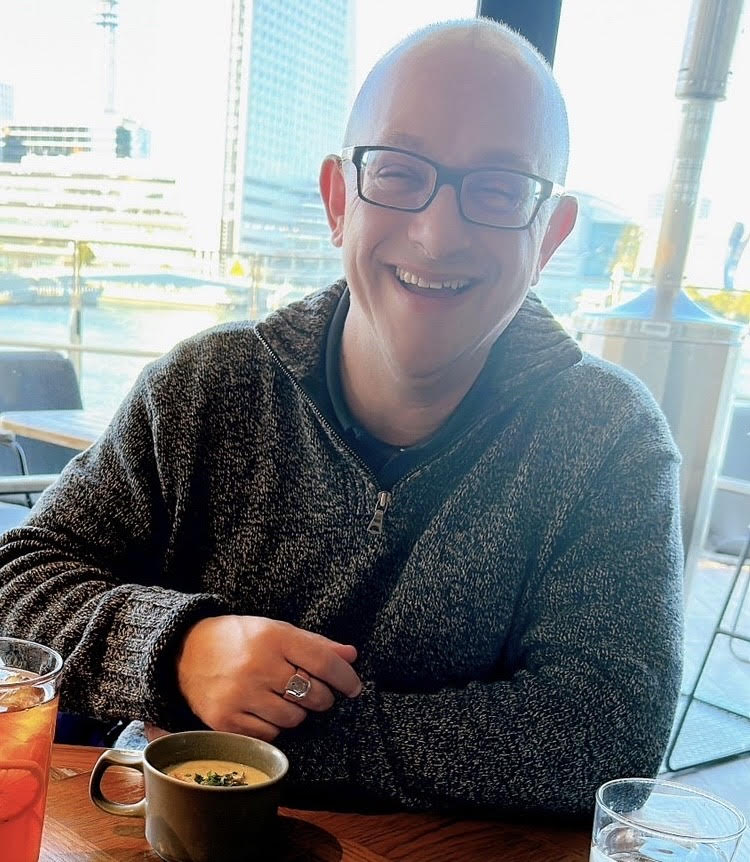
This is me. A photo taken in December 2022 at an outdoor cafe. Yes, I look happy. Because I am. Relaxed and in the company of friends, it was a very enjoyable lunch and conversation. It feels very different from where I was a year ago.

In Dec 2021 I was not happy. I was recovering from type 2 diabetes which was diagnosed in May 2021, and had been on months of medication, side effects of which were poor sleep and headaches. I had to endure those because I needed to continue to reduce my blood sugar. I was also under extreme stress at work. I was unable to help my stressed out team because I could not even help myself. Every day I felt like I was drowning, and there was no help to be found anywhere. The situation was relentless. I was working 70 - 80 hour weeks for months including nights and weekends and it still wasn't enough.  Every Sunday I would lie awake with anxiety at what new crises would happen the next day and I felt completely hopeless.

So, what happened?

By January of this year I became determined to change jobs. The internal transfer was not handled well, and that convinced me that I needed to change companies as well. I enjoyed my time in cloud technology but it turned out to be every bit as volatile as investment banking, and for many of the same reasons. I worried that at my age (55) despite my experience and skills I would struggle to find a good (enough) job, as I had in 2010 after I left JP Morgan. 

Fortunately, I was quickly able to find a great role in a buy-side asset management company's international sales department, leading a young and diverse team of developers, designers and UI specialists. My background in finance (albeit sell-side) and technology has been useful, as has my fluency in Japanese. I am doing good work and my work is being highly appreciated across the firm.

I learned a few very important lessons.

1) Sometimes what didn't really work out for you really worked out for you. Read that again.

Leaving the comfort and safety of Thomson Reuters (now part of LSEG) for "The Cloud" in 2016 was a very difficult choice to make. My current employer will make my 4th job in 6 years. Changing jobs is extremely painful and emotionally draining, and learning cloud solutions in my late 40s did not come easily. I had to invest a huge amount of time and energy on topics that others probably intuitively understood. However, if I had not gone through those tough times I might not have developed the important skills and understanding I need now to create the right solutions for my current employer. I met so many fantastic people and (hopefully) will keep and deepen my relationships in the future by being a good customer. If I had it to do over again, I would have had to choose the same course of events. As stressful as it was, it brought me to where I am now.

2) Prioritize Your Mental Health and Balance above all else

We often talk about the need for balance. This can be described as work/life balance but also as the "Holy Trinity" of mental/physical/emotional well-being that is the key to longevity. In my case, the high stress and anxiety led me to emotional and mental instability which ultimately contributed to my health issues. My poor health had knock-on negative effects on my mental and emotional health in a downward spiral that ended up out of control. In retrospect, I think emotional health was the most important factor to get right first. My happiness would have minimized my physical impact. Even working hard, if I had not been so stressed out/feeling hopeless constantly I think I would still have slept well, eaten better and found time to get more exercise. Many people can maintain a positive outlook even when they are not feeling 100%, but I think feeling despair will naturally disrupt mental and physical elements as well. No job, no career is worth jeopardizing any of the three factors and I am grateful I found another option before my conditions got worse. I felt that as a survivor of so many hardships, and a martial arts instructor as well, I would be largely immune from the effects of stress and anxiety on my mental/physical/emotional health. I was very painfully proven wrong.

3) There is ALWAYS something you can do - but you need courage (and to let go of your ego)

 As my situation deteriorated, I felt more and more helpless. I worked harder and harder, longer and longer, believing that I could work my way out of the negative spiral I was caught inside. I believed that if I got myself into a situation, any situation, I could get myself out. I told myself to "Man Up" and convinced myself I would do whatever I had to do to provide for my family, even die if necessary. I would have preferred to die than to fail, or so I thought. My family staged an intervention. It happened when my wife brought me dinner to my little room one night and told me that whenever she knocked on the door she worried that she would find me collapsed dead at my desk. She was very serious.

As a family, we spoke about it and they reassured me that this was not the way. I shouldn't risk my life for my job, any job, and that whatever changes I needed to make they would support me 100%. I made up my mind to get better. That would mean making changes. Major changes. It would also mean facing my fear of failure and letting go of my ego - stop trying to fight a battle I knew in my heart I could not win. I had to also stop worrying about what others would think of my many frequent changes - whether or not my bosses, my co-workers, my team or anyone else would judge me for throwing in the towel and quitting.

I had to believe that in the end, those who were meant to be my friends, those who really cared about me, would understand why I needed to do what I did. That is exactly what happened.

Far too many people fail to find alternatives to bad situations, or feel too trapped to make other, better choices. They worry too much about being judged or are too afraid of change. Far too many people fail to get the support they need or the mental health care they deserve. The truth is - it's never too late to make a positive change and a wait-and-see approach generally only makes matters worse.  

4) FUCK COVID

Yes, I said it. We've all been thinking it. This horrible disease has taken so much from so many, devastated families and workplaces, and even fundamentally changed the nature of work forever (hopefully for the better). I cannot and will not blame COVID for everything, but in my case it made a bad situation worse and added so much additional stress to an already challenging and difficult situation. During COVID, we were prevented from seeing each other, prevented from seeing customers or friends and this led to terrible feelings of workplace loneliness and isolation. Every day was a poor carbon copy of the day before - 10 or 12 hours of back-to-back Zoom calls and desperately trying to get a bathroom break in-between. No time for "actual" work and no way to build the all-important relationships that make work worthwhile at all. Everyone tried to make up for it with ergonomic chairs and virtual happy hours but they were all poor substitutes for actual face-to-face human interaction. I was miserable and COVID was a big part of that. No, the time of COVID is not quite over, but the world is finally moving on. One day all of this will be nothing more than a bad memory as we all mourn what we have lost and the high price that has been paid by everyone worldwide.

Closing

Happiness is not automatic or guaranteed. Part of knowing what it is comes from experiencing what it is not. 2022 has had its fair share of challenges, but I am very grateful to end the year in a far better place than where I started it.

I wish all of you a safe closing of the books on 2022 and all the very best in 2023.          

Sunday, December 18, 2022

Navigating Things


(thanks for the inspiration SC)

We are often conditioned to think of our lives as being on a kind of "auto pilot". We enter the details of our destination - education, hard work, dedication, perseverance, luck, money - and the Life Autopilot delivers us straight to --- SUCCESS. In many families, especially Asian families, the auto pilot includes enormous pressure to have perfect grades, play musical instruments and sports, excel at after school enrichment activities and if we do so, the autopilot will take us to success as a(nother) lawyer or doctor - ironically, even if this is not where we ourselves wanted to go.

We think we depend on a few critical "all-or-nothing" moments where our lives are defined. Those moments where we truly rise up and make the decisions and take the actions that will yield the fame and fortune we desire. Sadly, when we do not win those moments, we may feel that those doors to success are closed forever by our failure, and those potential futures lost to us. This way of thinking can cause us undue stress and anxiety and in some extreme cases may suggest to us that all is lost and we will never achieve our life goals - leading us to despair, depression and maybe even to self-harm.

In fact, Car Navigation systems may be a better metaphor than Autopilots.

Car Navigation systems are wonderful things. They allow us to input a destination and then provide directions to it, even allowing for various conditions to be set (don't use toll-roads, avoid traffic jams, etc.). These days, an intelligent AI voice tells us each turn to make and exactly how far to go.

Using this metaphor, like car navigation, sometimes despite the instructions we miss a turn off or overshoot an exit ramp or on ramp. Then what? A fiery ball of flame? No. The navigation system will calculate a new path to get us there. Even if you start going in the exact opposite direction of the system's instructions (like me when I use Google Maps), the system will patiently direct you back on course. Your journey is only truly over if you give up.

Life, it seems, is very much like this. Contrary to popular belief, we can even decide a direction without knowing the actual specific address. We can simply enter something close. We can change our minds en-route or make a detour or a stop off. We can make an unlimited number of mistakes. A new route will always display that tells us what to do from where we currently are. The Navi will always keep trying to show us the way. 

In the end, we will get where we are going as long as we don't give up.

When we are ready to accept our own freedom, we realize that there is no timeline or schedule for reaching our destination (success/happiness) except our own. The fact that others may have taken a faster route or arrived earlier or been more efficient is of no consequence. What matters is that in the end WE ARRIVE.

A Navigation system does not necessarily need every little detail to plot a course. Newest ones can use a partial address or even just a telephone number. They can navigate using a famous landmark or a place you have previously visited. Life, too, need not have every tiny detail in place to help guide you in the right direction. So get started. 

2023 is around the corner. Instead of just feeling lost, let the New Year bring you the chance to go on an adventure or two - secure in the knowledge that your trusty Navi will always get you there and back again.

Train hard.     

Sunday, November 20, 2022

Learning Kanji


Kanji (漢字) are the pictograms used in writing Chinese and Japanese. Originally Chinese, Kanji have been part of the Chinese diaspora and influenced not only Japanese but Korean as well. Many Koreans still have kanji associated with their names, and until recently there was still a kanji newspaper published in Korea.

I started studying kanji as part of my Japanese class in 1989 and have been studying them in one way or another ever since. Modern Japanese (newspapers) are based on a general usage set of 1,945 characters, but most adults know between 3,000 - 5,000 based on their education and interests. It is said that there are over 30,000 kanji in Chinese including very obscure ones and derivations.

I love the fact that kanji are pictograms rather than phonetic like western alphabets, since as they say, a picture is worth a thousand words. Kanji can be very efficient to transmit ideas to the viewer.

In the case of the above kanji, read "naka" or "chuu" in Japanese, it symbolizes the center or inside of something. This kanji was relevant in our class on Friday night.

In this cycle, we are working on hubud lubud (FMA sticky hands) applications including Hakka Kuntao, which is a southern Chinese martial art. I came up with the image of this kanji to reflect one of the central principles of Hakka Kuntao. In Hakka, our focus can be imagined as the four corners (both shoulders and the points of both hips) as well as the center line. Using the kanji, we imagine a square drawn connecting the four points with a line running down the center line (spine). Our objective then becomes penetrating the opponent's square to seek control of the center line, while simultaneously protecting our own square and denying the opponent access to our center line.

The shoulders and hips are predictive indicators of center line movement, so by using our peripheral vision we can anticipate the footwork (hips) or attacking line (shoulders) by watching the four corners of the box. Accessing the center line, usually via the head/neck/spine, allows us to easily compromise the opponent's balance and reduce or eliminate the ability to generate power through spinal rotation. Once this power train is disrupted it is very difficult for an opponent to deliver any meaningful strikes or recover their balance.

Hakka Kuntao is fast and powerful, concentrated on the box and center line, which makes it especially effective at very close ranges, despite the fact that many Wing Chun practitioners (Wing Chun is a representative Hakka martial art though not the only one) contend that it can be effective at medium and long ranges as well.

In Kali Majapahit, we use hubud lubud's framework to introduce several key bodies of knowledge including:

  • Gunting series
  • Hakka 5 Gates/Trapping
  • Application of aikido's te no tori drill
  • Knife and karambit flows
  • CQB stick trapping
  • Sarong and scarf applications

It is a cornerstone training tool and worthy of deep investigation and committed training.

More information here:

https://martialartsdigest.blogspot.com/2014/04/hubud.html
https://martialartsdigest.blogspot.com/2018/12/hubud-lubud-revisited.html     

Saturday, November 05, 2022

Reach Out


It seems like lately everyone is dying - more specifically, it seems like many people are committing suicide - either directly, or indirectly via alcohol or drug abuse.  Of course, notable celebrities attract attention regardless of whether they are rock stars, sports personalities or TV and movie stars.  This trend is discussed a bit in a paper here.

One of my country's greatest problems is one of multi-generational, hereditary poverty, a situation where Americans are born, live and die below the poverty line exactly as several generations before them did and just as they expect their children are likely to do.  This problem represents generations of families in the USA who believe, quite rightly, that they have been ignored by government - discarded in favor of a more influential middle class and wealthy elite who can donate and support them.  Exactly the constituents a candidate should advocate for, provided they actually cared about anything other than just remaining in office and milking it for every last drop of personal gain.  Sadly, these voices fail to have been heard for the better part of 80 years, leaving these groups of people in despair at being ignored and denied their basic human dignity and respect.

In the US we are taught to equate wealth with happiness, but the reality is not so clear.  According the to World Happiness Report, the largest study of its kind, the US ranks a sobering 18th, well behind many countries with lower GDP, notably including Costa Rica (13th). Money, it seems, is not everything.  However, we cannot ignore that those at or below the poverty line continue to suffer in misery with little hope for improvement under the current regime.

In many cases, these poor white people commit suicide.  In some tragic others, they act out on their feelings of resentment at their societal isolation and make a statement with their AR-15, shotgun or hi-capacity semiautomatic pistol.

The paper shows that despite these feelings of racist superiority, hereditary poverty affects whites just as badly as it does poor blacks and Hispanics, sandwiching them between lack of healthcare or quality education and perpetually low wages.  This leads to despair and desperation born of the hopelessness and fear of knowing that one's children will toil with no greater hope of success than any of the prior generations had.  So much for white superiority.

In another generation or two, the paper suggests, poor white mortality and imprisonment will equal or exceed that of black people, irrespective of police bias.  The race to the bottom continues unabated.

Sadly, this is an even greater argument for all of us to see beyond race, color or creed and to acknowledge that at the poverty line or below, all poor people have the same needs and must join forces to create social change.  For those of us above the poverty line, we are obliged in our compassionate society to give what we can to promote literacy, better education, healthcare and wage growth to help these people rise above.  We must influence action by our elected officials to allocate tax dollars to those who need them mist, rather than just enact tax breaks to further benefit the wealthy.  Overall, we must preserve the dignity of these people and remember that our country was founded on the principles of equal opportunity, acceptance and tolerance.

According to the very powerful book "Factfulness" by Hans Rosling, the world is far better than most of us think it is.  Dramatic increases in global wealth, education and health have been taking place and helping make a difference in the lives of many people, far fewer of which live in absolute poverty than ever before.  This is inspiring, and should remind us of our commitment to keep improving until not one single child is lost to preventable diseases, famine or war.

Meanwhile, at least according to our GOP, immigrants stream across the border to eagerly scoop up their entitled benefits of free education, low-cost healthcare and high(er) wages, thereby increasing the pressure on an already downtrodden demographic and adding exponentially to their feelings of despair.  Decades of systematically trying to skew the system against non-whites have failed, leaving "privileged" whites behind immigrants in both academics and opportunity.  In a desperate appeal to seize power not unlike 1930s Germany, our Republican Party appealed to the anger and hatred of this demographic and mobilized them to act out on their xenophobia.  America faces the darkest moments in recent history as we tear ourselves apart from within.  Our enemies in Russia, China and North Korea laugh as we push away our allies and descend into hopeless bickering among each other, all the while ignoring our fundamental moral compass as human beings.  This is the greatest tragedy of all.

The time for divisiveness is over.  The time for hatred and fear is ended.  Do not lose hope.
We must learn from our mistakes and put the past behind us so we can move forward AS ONE TRIBE.  The time for TOGETHERNESS is upon us.

Be Present
Send Peace
Donate
Hug
Love

BE THE LIGHT.


Friday, August 05, 2022

We're Here


"We're here to get through this thing together, whatever it is." - Kurt Vonnegut

The night air was cool and moist as we walked home. My teenage son was telling me about life at school. Instead of usual snarky comments and sound bites, he was opening up and telling me how he really felt. 

"The girls have two basic stereotypes", he said, "one group are really concerned about money, clothes and IG and showing off. The others sleep around, hang out in clubs and whatnot. Everyone is just trying to fit in." Surely they can't all be like that, I thought. It's hard being a teenager. Life is moving quickly and you're caught in the middle of definitely not being a child anymore but not quite having the wisdom or experience of an adult.

My own teenage years were... difficult. I was filled with anger at being a foster child and all it entailed. Sick of all of it, really. Bored and tired of social workers and therapists and of feeling lucky that things weren't worse than they were. I didn't feel like I fit in anywhere and I just wanted to get away from it all. It was the worst time of my life.

I told my son the above quote from Kurt Vonnegut, which had always resonated with me. I told him that I knew it was hard and confusing. Teenagers are expected to know their life plan and have it all figured out at 16. I'm still trying to figure it out at 56. One thing I am certain of is that we are not meant to go it alone.

Throughout  my life I have always found a small circle of close friends to help me get through this thing together, whatever it is. My tribe has been there for me no matter what, thick or thin, always. Together, we have laughed and cried (mostly laughed) and faced everything one way or another. Somehow, we got through. He has his circle and they are an important part of his life, too.

My Kali family (and more broadly my extended martial arts family) has been a real anchor for me. On the mats we work and sweat (and sometimes bleed). Off the mats we share and support each other. Without that element in my life I'm sure I would never have made it. I think you've got to have some true passion in life and share it with others to be truly happy. I'm lucky I found mine so early.

At 32 I was certain I'd always be single. I'm just not good at relationships - too extreme, too many mood swings. Haunted by too many ghosts and chased by too many demons. I just couldn't seem to make it work for more than a month or two. I spent most of my life trying to fix people, maybe in the hopes that it would prove my own self-worth. I couldn't save them, and as such I couldn't save/forgive myself. It was a negative spiral that just kept holding me down.

A year later I was married, now 22 years this year. I had found someone who wasn't broken and didn't need fixing - someone who was, and is, perfect just the way she is. Someone who, for reasons I can never understand, manages to love me even when I cannot love myself. Through her, my life has purpose and meaning and every good thing started with knowing she was by my side and had my back. That has made all the difference. She has helped me get through this thing, together, whatever it is. Because of her, it has been a good thing and worth getting through. Thanks to her I have never given up.

I told Ray that I bet there are lot of other people out there who feel like he does. Wondering and maybe a little bit anxious about what happens next. People who don't know why we're here or how to get through this thing, whatever it is. Just like me, all they really want is to get through it together - with someone they can count on and who will show up for them. If they could get past the plastic facade, the social media, the posturing, the virtue signaling. If they could open up and be real, then they would see him for who he really is - the man I see in him. They would consider themselves lucky to have a true companion in him, a person who can smile and laugh and who can be resilient in the face of hardship. Someone you can always count on to show you empathy and understanding. More than anything, they would recognize him as the best person to go through this thing with, together, whatever it is.

Don't worry son, she's out there. I know.

Wednesday, July 27, 2022

The Promise


(thanks for the inspiration George)

"It's all about the promise", George said. "That's why we watch. In the beginning, when the plot is being set up, they introduce the promise. Over the course of the show we see the promise fulfilled. That's satisfying. That's why we watch. We want to see the promise fulfilled. We want to see how it happens". He was talking about anime, one of his many hobbies. He could have been talking about anything. At the time I didn't realize it, but he was talking about martial arts, too.

George loves anime, and he wanted me to love it too. I told him they are cartoons for children. He frowned. "Cartoons don't have the promise", he said. "Cartoons are pointless.". It would take me another few years to really appreciate what he meant and, ultimately, to understand that he was really giving me insight into the heart of my martial arts training. My son had become my teacher.

 Many things in life begin with a promise. It represents a commitment to action to create a better future, a way of showing that we intend to deliberately deliver some future outcome. Rather than just a hope or a wish, a promise infers an initiative with a plan. When we observe the promise in media, often in movies, TV shows, graphic novels and the like the promise is  a way of framing the problem and establishing that the protagonist (sometimes the storyteller) will fulfill that promise in some way, often unknown to us at the time. It allows for quests, journeys, adventures, plot twists, mistakes, crises, hope, redemption - casting the ring into the fire of Mt. Doom, as it were. Like the One Ring, symbols can play an important part in representing the central struggle or premise of the promise. In many cases, the bolder the promise, the more intriguing the pathway to its fulfillment becomes for the audience, who become drawn in as participants to the struggle and its resolution.

Our life stories have promises as well. Promises we make to others but also promises we make to ourselves.
I would argue that martial arts training carries many inherent promises, and this is one reason why it is so different from just going to an aerobics class (aerobics is nice too, though). Martial arts training has a unique blend of "martial" and "art" that can accommodate any person across its spectrum from very martial to very artistic and everything in between. It allows each student to customize a journey in order to fulfill the promise to themselves to become a better version of who they want to be. Dedication and determination are the struggle, the quest, and the outcome years later is to have been transformed into a newer, better YOU. Stronger and faster, but also wiser and more confident. A version of YOU that is no longer afraid to challenge growth in all other areas of your life. It truly is a growth for mind, body and spirit.

When students are first starting out, I often introduce the promise as one from them to me, their instructor. The agreement is to keep coming to class, twice a week, as often as possible, to trust the training and that I will guide them in the Way and introduce the steps of the path. Eventually, once deliberate action forms a habit, they become able to keep coming to class routinely as part of their weekly activity cycle. Promise fulfilled.

Next comes the promise to themselves. As students rise in their ranks, I remind them of their progress and introduce the idea that they can promise to themselves to continue to set and achieve their goals. While I am certainly satisfied to see them moving forward, this promise is for them to experience the fulfillment that comes from keeping your promises to yourself. This means being self-motivated and showing up to class and giving 100% regardless of the weather, the workload or any of life's other distractions. The promise is a commitment to investing in your own personal growth. Often times this is punctuated by the achievement of a black belt, a symbol of overcoming the challenges of fulfilling this promise to understand the basic foundations of the art and becoming able to represent them to others. Promise fulfilled.

This is the time for the third promise - the promise to others.
I fully believe that when we align to our soul's purpose in this lifetime, the right people show up at the right time to help guide us to our next phase of understanding. It is the case in many stories but I think this is also true in real life. For me, moments of plateau, moments of crisis, moments of opportunity were always accompanied by the arrival of new characters in my story - people whose appearance was destined to help me see the way forward. For all of my life these people have arrived just when and where they were supposed to. I feel very lucky to have been shown how to develop the insight to recognize this. It was many years later when I finally realized that the tables had turned... I was now the one meant to appear at the right place and time for other people. As a leader, a teacher, an elder I had somehow become a guide rather than just a traveler. I felt a deep sense of responsibility to deliver on this promise and to be worthy of it in the way that so many people had been to me throughout my life. I have tried to raise my awareness and be able to see moments of influence where I needed to be able to be the right person to guide, lead and inspire others to help them fulfill their promises, too. Doing so seems to fulfill mine.

In the end we come full circle. Martial arts begins and ends with a bow - a symbol of respect for the art, for the teachers/fellow students and for the self. So too, martial arts begins and ends with a promise. A promise to fulfill for the teacher, for the self and for others.

Train hard.  


Sunday, May 01, 2022

Use the Difficulty


This is a great video from a great actor - a man who has stayed relevant and genuine in a career spanning more than 7 decades and over 160 films (and counting). He knows what he's talking about.

I found this video so interesting because it speaks to the heart of what we need to consider on our paths. All of us, every single one of us, experience trauma. We all have emotional wounds that can carry long-lasting consequences if left untreated.  This trauma can haunt us forever, or it can be used as a fuel to feed our fire for growth. We can become paralyzed with fear or turbocharged into action. It's up to us.

An actors' job is to convey various emotions to an audience through their portrayal of a character. The better they are the more we believe in who they become. The better they are the more we forget they are anyone other than who they portray at that moment. The best actors do much more than deliver a performance based on a script. They bring a humanness to the role that is unique and memorable. Method acting uses these powerful emotions to help actors create convincing characters.

Likewise, we can (and do) convince ourselves by the personas we create for ourselves. That's why it is very important to use the difficulty we have in our lives: the obstacles, the pain, the hurt, the sadness not as excuses to be stuck in place but instead in order to fuel our progress to something better.

Note that Michael Caine allows that difficulties can be used not just for dramatic purposes but also for comedy. Anyone who has been around me for any time at all knows my black humor - a coping mechanism I developed to face my many years in foster care. I laugh a lot because if I didn't I'd cry.

And as he says, "avoid difficulties if you can". True indeed. When you can't avoid the difficulty, USE IT.


Train hard.


Friday, April 29, 2022

coulda shoulda woulda


(Thanks for the inspiration MC)

The air in the changing room was heavy, palpable. I could feel it. I smiled and asked "How are you doing?" already knowing the answer... his face said it all. 

Lately we have been working on some BJJ basics as well as Kali Majapahit. Guro Jeremy has been training on weekends and has been kind enough to share what he is learning with the rest of us as part of our conditioning and as something to complement our usual KM curriculum. We are all beginners, including Jeremy and especially me. There is no ego, only a chance to play, explore and discover together, which for me is at the heart of what the FMA journey is all about. We do some warm-ups, some basic techniques, look for solutions to some common situations and even roll from time to time. I love it.

Three of the most dangerous words in the English language make the title of this post: Coulda, Shoulda, Woulda. With a magic wand I'd erase them completely. Why? Why are they so dangerous?? It goes back to the answer in the changing room... When I asked how he was doing, his expression dropped. "I don't know...I just think I should have done,,, better".  There it was. The Shoulda.  

I knew this feeling very well. When I started KM back in 2008 I already had three other black belts (Ninjutsu, Kenjutsu, Aikido) and had been doing martial arts for over 25 years. However, the movements of Kali Majapahit and the various subsystems (Hakka Kuntao, Silat, Jeet Kune Do) did not come easily at all. I always felt awkward and ashamed, as if somehow decades of experience in traditional Japanese martial arts could have prepared me for these new areas.  The reality is that they didn't and they couldn't. That was truly the best part because it challenged me in new and different ways that have led to a much deeper overall understanding. This is only possible once we get rid of the couldawouldashoulda

The Coulda: If only things had been different the result would have changed --- guess what, what happened happened. Now, how will you prepare for next time?
The Shoulda: Why didn't I do it differently?? --- guess what, you didn't. How will you do differently next time?
The Woulda: If only things were not the way they were... guess what, the way they are is the way they are. Now, what are you going to do about it?

These three dangerous words are rooted in our ego (our expectations of ourselves versus the evidence of reality), our overthinking of past events/giving in to guilt, our living in the hypothetical and abstracting the need for specific actions which lead to specific outcomes.  In each case, they are usually far more hurtful than helpful and can easily stall us in our development.

The Way challenges us to face ourselves as we truly are, without illusion, confronted by the evidence (positive or negative) of the environment we are in. Only from this true starting place can we plot a path to a different and more positive outcome. How can we determine where to go without first knowing and accepting where we are?  Of course, this includes the honesty of accepting our current selves as-is, limitations, failings and all, but ONLY as a part of the process of moving forward. NOT as a path toward despair, hopelessness or depression. We must remember that we can only know what we know, and be who we are right now in this moment. Not more, but also not less. As simple as this realization is, many people go their entire lives without considering it or without really accepting it.  Once we truly own ourselves as we are, we can start to take positive steps toward better goals.

When he told me "I don't know...I just think I should have done,,, better" my response was immediate. "Why do you think so? Have you trained BJJ before?" He said he had not. "Then there's no reason you should already be good at it, is there?" "He smiled and nodded his head. Sometimes the answer is so clear but we cannot see it through our ego.

We live in a world where perfection is expected. This is hardly the usual case but we tend to be disappointed with anything less than perfection, often from ourselves. Don't believe me?  Ask Einstein.  All the superstars we see were not born like that. It takes hard work, dedication and sacrifice to achieve excellence. Being present in the moment gives us an important signpost which helps us to see our progress from where we were, and how much closer we are to where we are going. In the end, this is what really matters.

The Path can be difficult. It's important not to make it even harder by putting unrealistic expectations on ourselves or others. We will almost always have to make decisions or take actions based on incomplete information, finite resources and sub-optimal timelines. We will need to get it done anyway. 

So trust in yourself and the process, stay the course, do the work, and the results will come. I promise.

In the meantime, train hard.